About back mirrors, something not many people know… Older bikes are basically fine, but…
If you’re unsure, sticking with the stock mirror is the safest bet!
A strange world where you can’t even change the mirror… It’s frustrating, isn’t it? (´ρ`)
All vehicles manufactured on or after January 1, 2007 (Heisei 19),
all vehicles with model type certification on or after January 1, 2005 (Heisei 17)
1) The mirror surface area must be 69 cm² or larger.
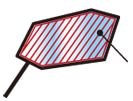
Any shape requires 69 cm² or more
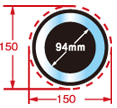
2) For circular mirrors, the mirror surface diameter must be 94 mm or larger and 150 mm or smaller.
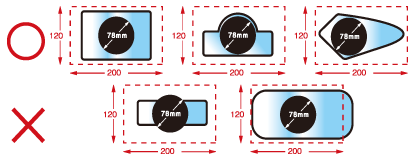
3) For non-circular mirrors (rectangular, oval, etc.), the mirror surface must be smaller than 120×200 mm (or 200×120 mm) and must be able to conceal a circle with a diameter of 78 mm.
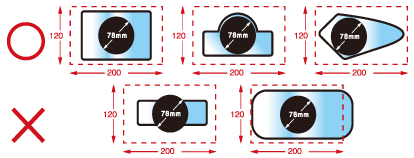
The 78 mm circle is not concealed, so the overall width exceeds 200 mm
4) Regulations other than mirror surface size (mirror reflection range, mounting conditions, etc.) ※Partial excerpt
- Mirrors must be mounted on both the left and right sides of the vehicle. (Some exceptions apply)
- The structure must be able to absorb impact if it contacts pedestrians, and must not cause injury to pedestrians.
- The center of the reflective surface must be on a vertical plane passing through the center of the steering device and parallel to the direction of travel, or 280 mm or more to the outside. etc.
Vehicles manufactured on or before December 31, 2006 (Heisei 18)
Vehicles with model type certification on or before December 31, 2004 (Heisei 16)
1) There are no mirror surface regulations.
2) Regulations other than mirror surface size (mirror reflection range, mounting conditions, etc.) ※Partial excerpt
- Mirrors must be mounted on both the left and right sides of the vehicle. (Some exceptions apply)
- Traffic conditions 50 m along the left and right outer edges of the vehicle must be visible. (Some exceptions apply)
- The structure must be able to absorb impact if it contacts pedestrians, and must not cause injury to pedestrians.
- The center of the reflective surface must be on a vertical plane passing through the center of the steering device and parallel to the direction of travel, or 280 mm or more to the outside. etc.
※Two-wheeled motorcycles manufactured on or before November 30, 1975 (Showa 50) have different mounting conditions, etc. ※For mopeds (125 cc or less), if traffic conditions within 50 m along the left outer edge of the vehicle can be confirmed, the above regulations do not need to be followed.
※For information about safety standards, see
- This applies to mopeds, two-wheeled motorcycles, motorcycles with sidecars, and three-wheeled vehicles equipped with handlebar steering devices and without an enclosed cabin.
- This applies when vehicle users modify the structure, equipment, or performance of vehicles or parts in use, such as by installing or removing equipment or similar actions.
- This applies when replacing a typical motorcycle back mirror with aftermarket parts. (Regulations differ for trikes, vehicles with enclosed cabins, etc.)
For more details, see
- Road Transport Vehicle Act
- Road Transport Vehicle Act Safety Standards (Article 44, Article 64-2)
- Road Transport Vehicle Act Safety Standards Details Designation (Article 146, Article 267)
- Road Transport Vehicle Act Safety Standards Chapter 2 and Chapter 3 Applicability Coordination Notice (Article 52, Article 70)
.