Since the weather was nice, I left the shop door open, and wouldn’t you know it—that thing came in along with the mosquitoes!?
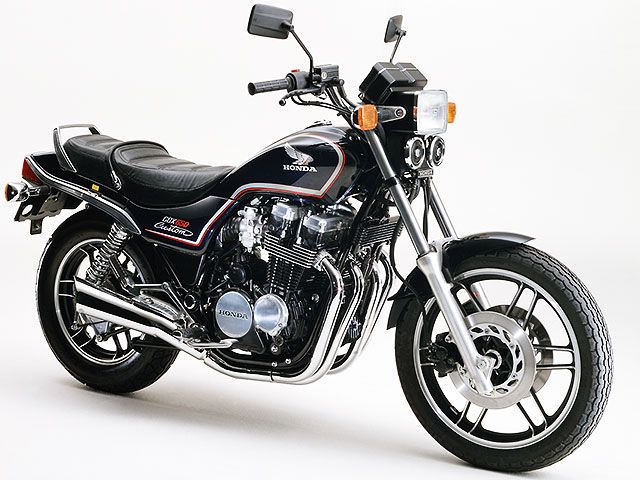
Someone wants to buy this rare bike… a CBX.
It’s a CBX, but a 650C!? To be honest, I don’t know anything about it and have never even seen or touched one.
Unless the owner has serious guts and determination, the time, effort, and money will never stop flowing—that’s my hunch.
At first glance, what worries come to mind…
The carburetor, intake manifold, and head cover gasket, I’d say.
At minimum. At the very minimum.
If those parts aren’t available, it gets rough.
Overflow won’t stop, oil leaks won’t stop, but gaskets aren’t available.
You pull the carb off and the intake manifold cracks, or once you take it apart, the carb won’t fit back in—you can imagine all sorts of possibilities.
Are fuel petcocks and gaskets even available?
Fuel petcocks usually have good compatibility.
You’d think you could make it work, but sometimes you can’t figure out how to handle it until you actually try.
The beauty of OEM parts is that you order them by part number, they arrive, you inspect them, and you install them.
No worries (*’ω’*)
Just having OEM parts available cuts down the work dramatically.
Brake discs and sprockets—surprisingly troublesome.
For softer rare bikes, you can usually get them from Sunstar.
For true-blue rare bikes, that’s not always the case.
Custom work might naturally call for it, but one-off consumables are basically something you want to avoid.
When you start thinking about lead times on replacements and the possibility of finding someone to maintain the bike going forward, there’s no end to it.
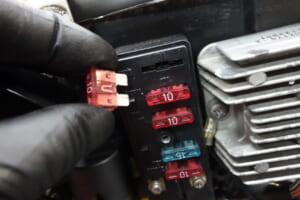
Old bikes always have those mysterious electrical components.
The headlight bulb burns out and the high/low beam switches over.
You forget to turn off the turn signal and after riding a certain distance it shuts off by itself.
The regulator and rectifier are separate units.
A dreamed-of future that seemed convenient… but turned out not to be so convenient—these kinds of OEM parts sometimes come installed.
For example,
if you swap in an LED headlamp, it gets misidentified as burned out and won’t work right,
or the turn signal doesn’t work properly, so you end up having to replace the left switch too…
There are plenty of things where you wonder why they laid it out this way!?
The engineers back then must have thought it through carefully, but looking at it now!?… might be the case.
Find a specialty shop or a bike shop run by someone who owns one of these bikes.
That’s the shortest path.
It’s the same with everything—if you don’t know something, you have to research and learn about it.
If you enjoy this kind of digging or find it fun, you need to dive in headfirst.
*Personally, I have no desire to dive in at all.
Otherwise, you just have to learn on your own and carve your own path.
Lately you can source parts from overseas too, so the means of survival are increasing.
Spending your days hunting for shops and parts online might be fun too!?
In the end, without guts and determination, you might not be able to keep up with it!?
*Do your own research. That’s the basics.