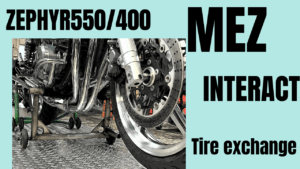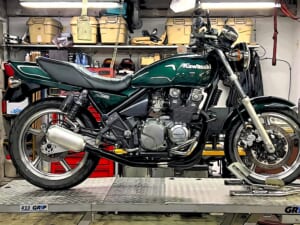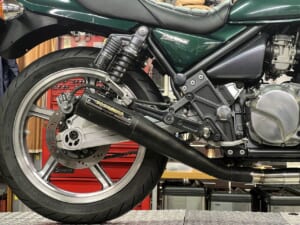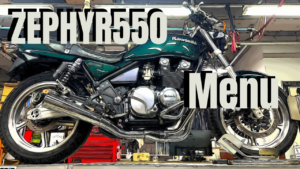
I bought the ZEPHYR 550 on a “whim” and “impulse buy.”
I didn’t particularly want it, nor did I have any special admiration for it.
I was just inexperienced with motorcycles at the time, and I have a distant memory of test-riding a Zephyr 400 back in high school.
The gap between my memory of the 400 back then and the 550 felt enormous. They’re completely different machines.
I happened to purchase an old magazine “KAWASAKI ZEPHYR Part1” and after reading it,
I found myself deeply nodding in agreement and thinking, “Ah, I see!”
Since this magazine has become quite rare in the used market, if you get the chance, I’d really recommend picking up a copy.
Let me share just a little bit about it with you.
“Riding the Zephyr 550 along America’s West Coast” —a project that would be unthinkable today.
I’m not sure if it was by chance or intentional, but why the Zephyr 550?
Wouldn’t a test ride project with the 400/750 domestically have been just as good? That’s what I thought. *Did they have a generous budget?
Or perhaps it was a somewhat niche idea—
the Zephyr 550 exists in America, and the project was born to match that.
Personally, I’m just happy that the cover features the Zephyr 550.
Even in America, where liter-class machines are everywhere,
the Zephyr with its modest 550cc displacement is apparently quite popular.
Visually, the Zephyr 550 looks almost identical to the 400. The design work is the same, of course.
Down to the finest dimensions, the 550 and 400 share the same specs.
However, the 550 has a decal on the tank with “Kawasaki” logo directly below “ZEPHYR,”
and this is the only distinguishing point in appearance from the 400.
The riding position is, of course, exactly the same.
In dry weight, it’s 2kg heavier than the 400, but such a difference is imperceptible to the rider.
Only the mile-marked speedometer and the headlight’s always-on system remind you that this is an American-spec Zephyr.
The 550 has a decal on the tank with “Kawasaki” logo below “ZEPHYR.” We were able to learn such information.
It’s a bit of niche trivia that really hits the spot.
But once you start riding,
the 550 engine, with its bore 3mm larger and stroke 10.4mm longer than the 400, surprises you with its unexpected power.
The way the torque builds is completely different from the 400.
The sharp acceleration off the line is actually closer to the 750 Zephyr than the 400.
Reading this part, I actually felt the same way.
It wasn’t so much amazement at the contrast with the 400, but rather pure surprise at the Zephyr 550’s performance.
After riding it on both local roads and highways, what struck me was “Man, the Zephyr 550 really goes!”
With this engine performance in this class, it’s just right—easy to enjoy for long rides. That’s what I thought.
However, if you actually compare it to the 750,
this one is more an engine you ride by revving rather than by torque.
Yet strangely, even though the Zephyr 400, 550, and 750 models
each have completely different power characteristics, when you actually straddle the bike and start riding,
you sense a common thread running through them.
Perhaps it’s what you’d call the Zephyr taste,
a unique concept that transcends displacement and absolute power, flowing steadily through the foundation of the Zephyr —you can feel it.
Such a gentle, mellow expression that appeals to all Zephyr users really tugs at an owner’s heartstrings.
I’ve been writing about the Zephyr 550 on my blog day after day like this.
For people thinking “I wonder if I should get one…”
the positive vibes are probably coming through loud and clear, aren’t they?
Use responsibly.
Until now, I had always believed that the true thrill of motorcycling lay in cornering.
But a motorcycle that’s fun even going straight, enjoyable even on long rides over long distances—
this is what a motorcycle should truly be, I came to realize
after completing a 1000-mile journey along America’s West Coast with the Zephyr.
I felt this deeply.
That’s right— the 550 has just the right class and an excellent balance of torque and power.
In terms of motorcycle performance, of course,
but also in design, maintainability, and many other aspects, it excels. That’s the kind of bike I think it is.
Surprisingly, this magazine is from 1991—33 years ago.
It doesn’t feel that old to me, but when you do the math, it’s shocking. Time really does pass…
Interestingly, old motorcycle magazines were made with considerable passion, so even now they’re enjoyable to read and savor.
If you get the chance, pick one up and flip through it—you might discover more than you expect.
The article was not found.