Whether something is good or bad might depend on what you’re comparing it to.
If you don’t have a clear purpose in mind, I might not recommend an aftermarket meter that much?
(Including the cost aspect…)
Well, the cockpit does look super cool though… (*´▽`*)
(´∀`*) Ufufu The big sale once a year—Amazon Prime Day 7/12・13
For a one-off installation, you need to factor in the cost of another meter…
A 200,000 yen meter with 200,000 yen installation?? …
Not everything is like that, of course.
But it’s really a hassle.
*Our shop isn’t a custom shop, so we don’t do that kind of work…
Fabricate the bracket and layout →
Layout the sensors and fabricate the bracket (pretty important) →
Wiring layout →
Meter settings (including reading the manual thoroughly) →
GPS meter app, so check it on a test ride and you’re done
This is the flow for an analog carburettor bike.
The time spent thinking and machining, plus the time spent on wiring, becomes enormous.
The ease and durability of the stock meter is unbeatable (*´▽`*)
First, the meter itself is incredibly light, which is nice.
Next, if it’s from an instrument shop, you can usually get an overhaul done almost anywhere, which is hard to pass up.
No settings needed—just bolt it on ♬ A stock meter is nothing more and nothing less.
It’s the definition of stock.
However, the meter can’t display water temperature, oil temperature, oil pressure, a clock, lap times, and so on, so you have to line up aftermarket gauges around it.
No matter how neatly you arrange them, it gets cluttered.
In that case, an aftermarket meter might be the way to go.
Finally, you can’t change the settings… It’s hard to adapt to changes in final drive ratio or tire diameter.
All-in-one vs. clustered gauges (*´Д`)
This comes down to preference, so I can’t really say which one wins.
Clustered gauges display everything right in front of you.
It’s very easy to see all the conditions at a glance.
You can check temperature, speed, and RPM all at once!
It might feel like a fighter jet cockpit. You really get to enjoy the best of analog gauges.
Try calculating the total cost of clustered gauges sometime—it’s interesting.
You might be surprised to find you could actually install a pretty decent meter for that amount.
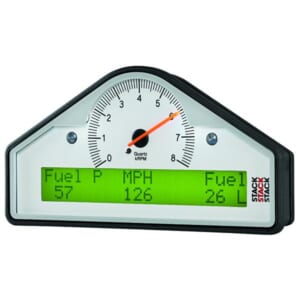
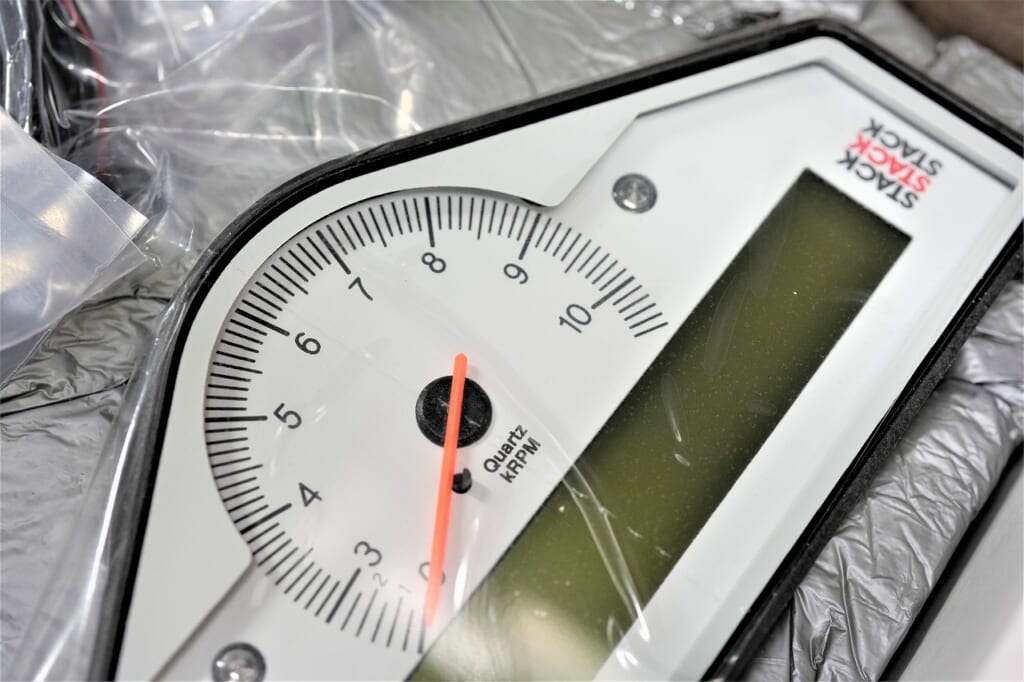
An all-in-one meter is really just that—very simple.
You can remove the one meter and send it in for repair right away. The display is as simple as it gets. The layout flexibility is also very high.
It might not be ideal if you want to check lots of information at a glance in large text. But maybe that’s only for racing? When you think about design and cost, choosing an aftermarket meter is a good idea.
The stock meter’s finish is super high, so valuing the original’s strengths…
That’s a valid choice too (‘ω’)ノ