Hoke hoke~♪ Yeah, the nights are peaceful and that’s nice—really!
Not loud! It’s cool☆ This is the season when the sound of insects is so pleasant. (Though they haven’t started chirping yet.)
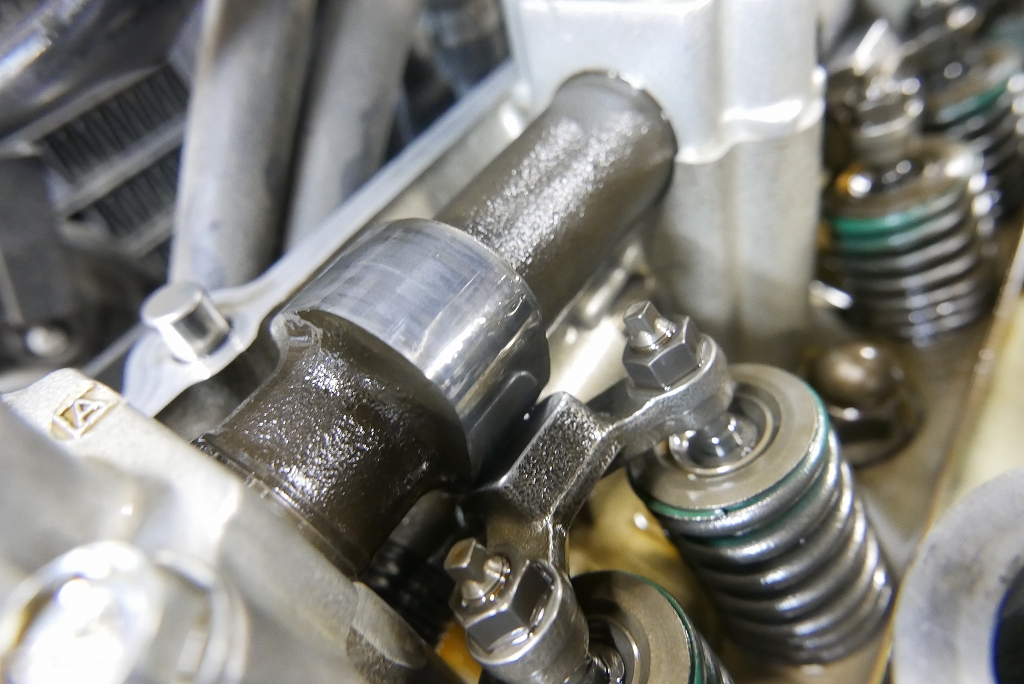
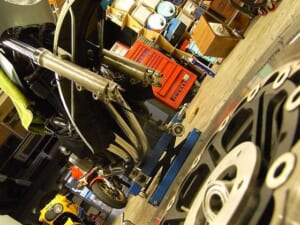
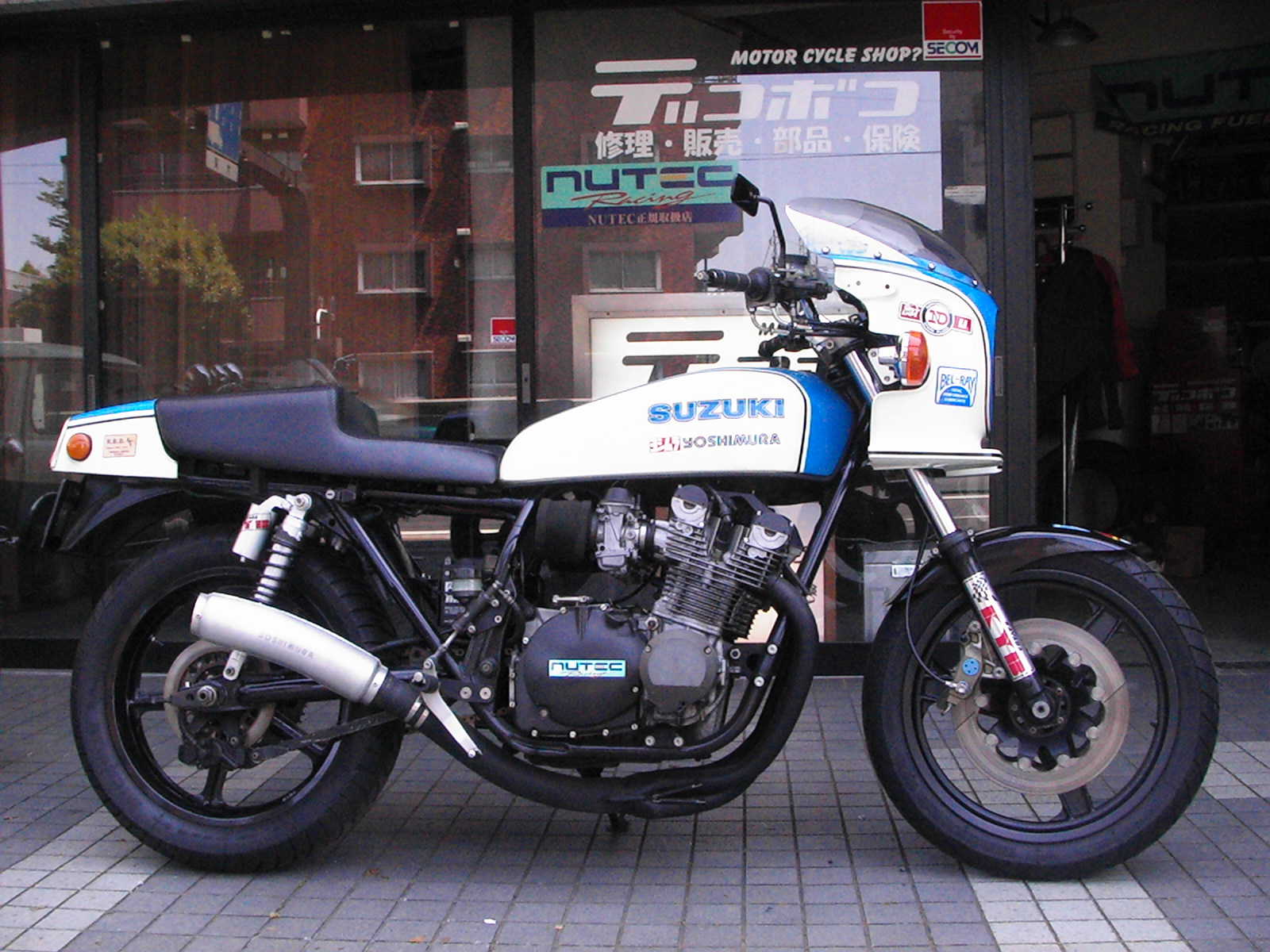
Today I happened to be swapping out the cam on a GS1000—not an oil-cooled bike for once—and it brought back old memories.
Back in the early Asakawa Speed days, you needed manpower in a way that’s unthinkable now.
So few machine tools! Seriously, we had almost nothing.
Just a drill press, a double-ended grinder, an electric drill, and a grinder—and all of them ran on 100 volts.
And on top of that, we worked outside under a tent (hot in summer, snowy in winter, but still outside).
Man, you really needed guts! Seriously☆
I got to work on all kinds of amazing bikes, and I still think the experience I gained from that was enormous.
The reason I’m writing all this is that to adjust the valve timing, I’d slot the cam sprocket with elongated holes,
and back in the AS days it was all done with a hand file! And not even a good one—I don’t know where half those files came from, they’d wear out fast, cheap things.
We’d have Z engines, GS engines, oil-cooled engines coming in, and Asakawa would ask me to “slot those for me,”
.
Cam sprockets have hardened surfaces, so they barely cut at all, but once you get past the hardened part, the inside actually cuts pretty easily!
You’d just file away for nearly an hour straight☆
Then once that was done, you’d do the “Calshard” finish with sandblasting…
That was the worst! Back then we did everything ourselves—painting, sandblasting, all of it in-house!
Sandblasting was a full day’s work, starting in the morning and going until early afternoon, and since we built the sandblaster ourselves, it was rough—
sand would leak everywhere, so you’d be covered head to toe in sand… I was so sick of it~
During this period we were renting a little space from Mazda Speed, so after sandblasting we’d head to the hellish wash room for
engine cleaning…
There were three wash stations and this monster tank. First you’d do a rough wash, then into the monster tank! It was big enough for a person to fit in,
kind of like a spin dryer if you will☆ It would blast you with scalding hot water and shake everything around!
When you pulled it out it was too hot to touch. Then you’d do a middle wash and a final wash, and the washing was done!
Last, you’d carefully blow out all the oil passages with compressed air, and by the time you finished it was already 6 or 7 o’clock.
Being in the wash room messes with your sense of smell, and washing by hand really does a number on your hands! They’d turn bright red.
It was rough, really♪
But we’ve taken that experience and used it to improve efficiency. Today’s micro rotary tools are seriously convenient—
cam sprockets just slice right through! Wonderful!
And if we’re not satisfied with that, well, for slotting you could put a circular cutter on the mill and get a cleaner, easier result♪
I decided to buy a circular cutter!
Taking time to do things right matters, but since time is finite, to make the most of it you really need to improve efficiency and create a more comfortable
work environment.
This month the wash room and machine shop are getting finished, so lathe and mill chips won’t scatter as far and we won’t need to do as much cleanup,
which should really boost our efficiency.
There are only 24 hours in a day, and with just 2 arms and 10 fingers, you want to work as efficiently as possible♪
I’m really into the mill these days! (I put all new teeth on it, so it cuts like a dream~)