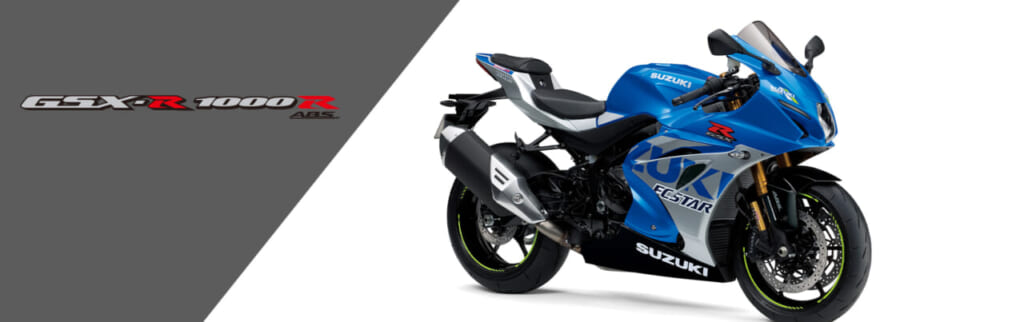
The GSX-R series has gotten a little refresh.
Maximum output: 145 kW (197 PS) / 13,200 rpm
Maximum torque: 117 N·m (11.9 kgf·m) / 10,800 rpm
Looking at the specs these days is just amazing… ( ゚Д゚)
When you consider that every single spec surpasses the 20th century TT-F1 race bikes and 8-hour endurance machines, yet this is a bike that idles on city streets and anyone can ride, you can only marvel at the progress of modern technology.
Take a look at modern technology (GSX-R specs) for a moment (*^-^*)
Suzuki Easy Start System
“One-push engine start”
Equipped with the Suzuki Easy Start System for one-push engine starting. When you press the starter button, the starter motor rotates for a set time. The ECM (Engine Control Module) recognizes the starting condition and stops the starter motor. The Suzuki Easy Start System and the idle speed control system that stabilizes idling improve cold starts and contribute to reduced emissions. Also, when starting, if you’re in neutral, you don’t need to pull the clutch lever.
Low RPM assist
“Improves operability in city riding with repeated acceleration and deceleration”
Low RPM assist is employed, which controls using information from engine RPM, gear position, throttle opening, and clutch switch during acceleration and low-RPM riding. The engine RPM dip during acceleration is eased, realizing smooth takeoffs. Also, during slow-speed driving in traffic or when making U-turns, you won’t feel the engine RPM drop as much, giving you peace of mind.
Motion Track TCS (Traction Control System)
“Combined with S-DMS, choose from 30 settings to efficiently transmit drive to the rear tire”
Motion Track TCS (Traction Control System), which efficiently transmits driving force to the rear tire, allows you to select the traction control intervention level from 10 modes to match road conditions or personal preference and experience level. The instrument panel displays the selected mode, and when Motion Track TCS is intervening, the TC indicator flashes. Motion Track TCS detects rear tire spin using information from front and rear wheel speed sensors, throttle position sensor, crank position sensor, gear position sensor, and vehicle motion and attitude data. When rear tire spin is detected, it quickly reduces engine output. Engine output is controlled by adjusting ignition timing and throttle valve opening, automatically controlling engine output. Motion Track TCS receives information from each sensor every 0.004 seconds, performing highly accurate detection. Using signals sensed by the IMU, it calculates motion and attitude. Mode selection is possible when the throttle is fully closed.
- The traction control system does not completely control rear wheel slip (spin) or prevent falls under all conditions.
Suzuki Drive Mode Selector (S-DMS)
“Choose from 3 modes according to your preference to select how the power delivery rises”
The Suzuki Drive Mode Selector (S-DMS) allows you to select any of three riding modes—A, B, or C—using the left handlebar switch to switch the engine control map. In various riding conditions such as winding roads, city streets, and high-speed cruising, you can select a riding mode that suits your preferences.
Combined with the 10-mode traction control system, S-DMS offers a rich variety of output characteristics to choose from.
Bidirectional quickshift system (2 modes + OFF)
“Frees you from clutch operation during shifts, giving you more confidence in your riding”
Equipped with a race-type bidirectional quickshift system. Riders can shift up and down without clutch or throttle operation.
During upshifts, output is automatically cut, momentarily relieving the driving torque load on the transmission gear dogs. Even at full throttle, smooth and speedy upshifts are possible, delivering nearly continuous acceleration. During downshifts, without throttle blipping or clutch operation, the throttle valve automatically opens and engine RPM rises to match the next gear ratio, enabling speedy and smooth downshifts.
The quickshift system senses shift linkage movement and stroke, shift cam rotation, and throttle valve position.
Anyway, I’d end up just copying and pasting everything, so I’ll stop here…
In any case, the electrical control technology has improved wonderfully and it’s amazing.
You only use the clutch at takeoff, and during the rest of your ride you barely touch the clutch at all, so those of us who ride carburettor bikes might feel a bit of a disconnect, myself included.
Or rather, we might need to get used to this modern way of operating.
It’s like comparing a smartphone to a rotary phone.
I find myself nostalgically thinking about how we used to actually remember phone numbers back then (‘ω’)ノ
Now you just say “HEY! SIRI, make a call!” and you’re done… I think it’s something like that.
Two tires, same as always… Welcome to the 21st century!