There’s no doubt that electrical DIY work is the most frustrating part.
Loose terminals, multi-taps, parts that can’t be removed without cutting, different colors on every connection, and so many of them (and they come loose from the terminals too).
Ultimately, you want to install electrical components yourself, right?
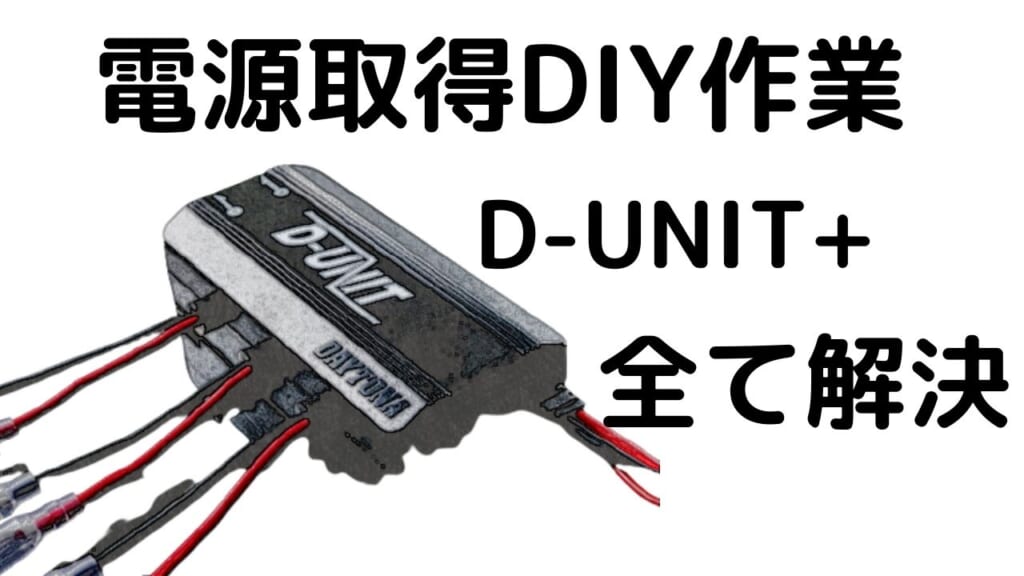
If that’s you, installing a Daytona D-UNIT+ solves everything!
We’ve covered it in an older YouTube video.
When I think about what you’d want to install…
• USB
• ETC
• Digital speedometer
right?
Of course, it’s also perfect if you need to tap power for other devices.
Getting three separate power sources from the frame is quite tedious work.
You don’t want to tap three lines from the same spot, and then there’s the appearance issue and the fuse problem.
The biggest problem is that you can’t get ON 12V and ground in parallel.
You end up tapping power from wherever you can and grounding to a nearby bolt with a shared fastener, which is the typical pattern.
When you do this, each device ends up connected in a “Y” configuration, which looks messy and is hard to service. Since you do this for every device you install, your wiring ends up looking like a plate of yakisoba.
The fuse locations for each device end up scattered all over.
That’s a real problem too. If a fuse blows, you won’t know where it is, so you have to remove all the fairings to find it.
Keep troubleshooting in mind.
The benefits are:
• Fuses are centrally managed, and with low-profile fuses, it’s compact.
• Connection is simple: just constant 12V, switched 12V, and ground. If you’re unsure, just connect to the battery terminals and brake switch. Removal is easy, and no modifications to the harness are needed.
• You can get three power sources and ground in parallel.
Say goodbye to shared-bolt grounds and multi-taps.
• Swapping devices is as simple as unplugging and replugging.
If your USB power dies, you just swap it out—super easy.
• Direct battery connection means stable voltage.
A voltmeter will show readings very close to the battery itself. This also stabilizes the voltage to your devices. I’ve never tried it, but you could probably use it to power an ignition coil too. Plus, in case of trouble, you can tap power and ground from a separate circuit on the harness, which is fantastic.
I’ve written only good things, but there are downsides too.
For the price, it feels “very cheap.” The cover breaks easily if you’re not careful.
If you want clean connections and the wiring is too long, you’ll need to modify it.
Aside from that, it’s all good. Since I started using this, wiring work has become so much easier.
If you want to do any electrical work yourself, you absolutely must buy a D-UNIT+ and connect it first. Actually, I really think you should use it (*´▽`*)