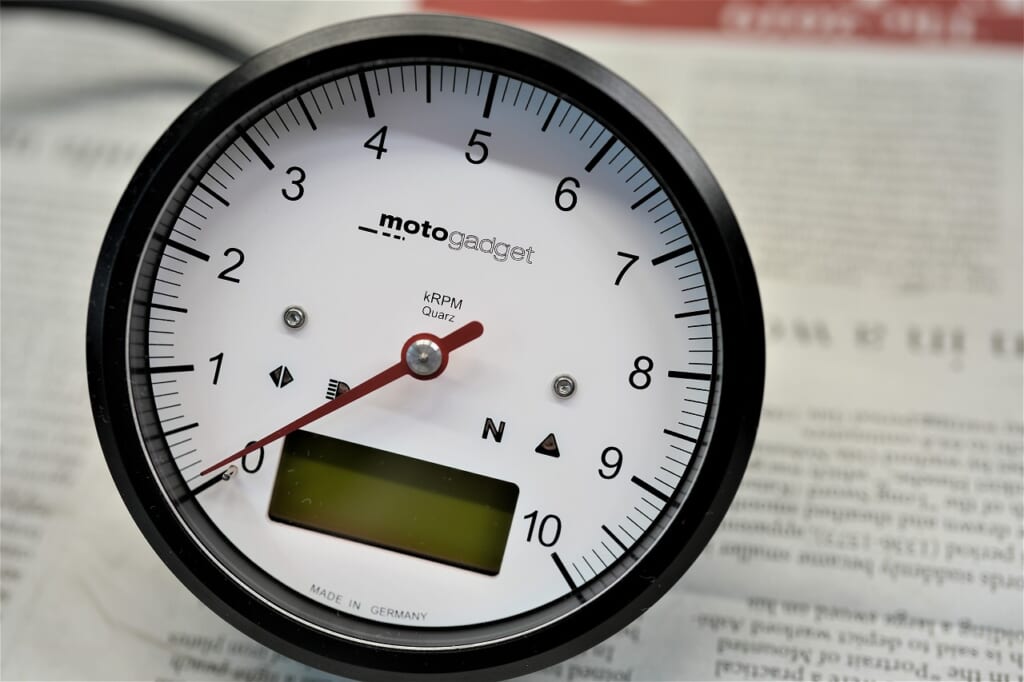
I really do prefer a white panel with an analog needle meter, you know? (*’ω’*)
Since I’m always doing dirty work, I think white parts look nicer…
that’s what I think.
Just kidding…
Basically, black absorbs light easily, so degradation is inevitable.
The same goes for exterior parts.
If you leave it sitting in scorching heat, it gets piping hot, so
please be careful… (*’▽’)
Now, aftermarket meters come in all price ranges, from budget to premium.
So what’s the real difference?
Honestly, if you’re using it on a carburetor bike, there might not be much functional difference.
Especially on air-cooled bikes…
Speed, RPM, gear position, coolant temperature, oil temperature, oil pressure, voltage, indicators, and lap timing—that’s about it. Basically, there aren’t many sensors available, and there’s no way to add more information than that in the current state.
It’s kind of like a watch? The self-satisfaction factor goes up…
If a watch only tells you the time accurately,
think of it like a smartphone or quartz being reliable.
Affordable with sufficient function—that’s what the budget meters sold out there are like.
But in the cockpit, you want a nice meter with a brand logo on it…
Same with watches, right? Think of it that way…
It’s a kind of status and satisfaction feeling.
If you just want to swap the meter and pick something cheap, honestly the stock one is fine…
The meter is always in your field of view while riding.
You want to enrich and satisfy that world view… That’s what it’s about.
But racing use is different.
You need visibility, the ability to change settings, various alarms, and logging functions.
Those functions need to be there.
In terms of meter functionality alone, the stock meter’s durability is truly wonderful—safe and reliable.
It’s priced fairly, and there are tons of shops that do overhauls, so you can use it long-term with confidence.
I’d like to write down my subjective criteria for choosing an aftermarket meter.
① Looks cool at a glance
This is really important. The satisfaction is incredible. Cool or not is basically subjective, so pick what you like.
② Speed sensor that doesn’t use the magnet-pickup type.
Magnet types are really tedious. The more pulses, the less loss and the smoother the speed changes.
③ Fine adjustability.
It’s better to be able to fine-tune ignition cylinder count, speed pulses, and tire circumference.
It’s necessary to measure with a GPS app when using the stock meter.
If you start adjusting based on vague standards like “it was X km/h on the stock meter,” there’s no end to it.
④ Choose motorcycle-specific models.
If you pick motorcycle-specific ones, waterproofing, splash resistance, and vibration resistance should be covered.
I love the STACK ST8130 and use it, but it’s basically a four-wheeler.
Waterproofing and splash resistance are basically not there. *It handles some moisture okay.
Since it has silica gel packets inside the meter—a terrifying finish—don’t think you can treat it the same as a stock meter.
⑤ Too small hurts visibility.
This is obvious, but the word “all-in-one” appeals to the general public.
The motogadget in the image above is digital with small text, and you basically can’t see the speed. You have to cut something to keep it simple.
If there’s no bolt-on kit and it’s a one-off installation, you’re looking at another one or two meters’ worth of cost.
You need to think about what you ultimately want your machine to look like.
It’s a bit hard to convey, but…
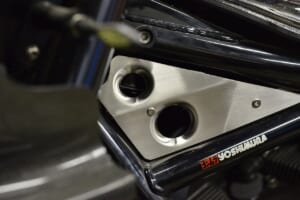
Say you made a custom panel and installed a STACK tachometer, Active Digital Speed, Yoshimura digital temp, and Daytona indicator.
With that many, you’ve got lots of wiring and sensors. Makers are all different, and later you might find sensors aren’t available.
When you think about the final total cost, if you’d just picked the STACK ST8130 or AIM MX from the start…
it would’ve been much cleaner and simpler, you’d think.
Recently, overseas models include GPS meters too. (Not street-legal.)
Installation is super simple—just power, ground, and RPM pulses… speed comes from GPS.
What a great time to be alive.
Meter swaps are mostly self-satisfaction for street riding. But swapping meters really does boost your enjoyment while riding.
Your eyes and heart get nourished—that’s the feeling.
By the way, please have a custom shop do the installation.
We don’t do it here at Decoboco. (*’ω’*)