What are we comparing when we say the clutch is light or heavy?
That’s why we get nowhere saying things like that… (゚Д゚)
Like “my phone is so heavy~” or something…
What would be light then? Are we comparing it to a feeling? I guess…
I found some kind of magic trick for lightening the clutch the other day…
It looks pretty sketchy.
I think what’s easy to handle is something that doesn’t strain your grip strength too much, has a wide adjustment range for engagement, and offers good operability.
It’s interesting to experience the difference in how hydraulic versus cable clutches engage.
Impression of the stock horizontal-mount hydraulic clutch master
When you switch to a radial master (excluding a certain brand), even with hydraulics the operability becomes extremely easy to handle. It feels closer to a cable clutch?
The stock horizontal master has a rough feel to how the half-clutch engages.
Even if you release it just a few millimeters at a time, there’s no gradual, gentle engagement.
It feels like it suddenly grabs partway through.
That explains why some people have unusually long half-clutch phases… vroom~~ ♪
With a cable clutch, your feel syncs with the clutch action.
That’s my impression of the operability (subjective).
It’s convenient when you want to cut just a little (slight half-clutch), and smooth takeoffs are easy to control, so I love cable-type clutches.
I talk about the beauty of cable clutches by saying the feel syncs with the clutch!
Compared to stock, it’s definitely heavier.
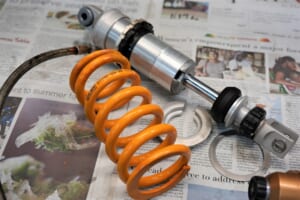
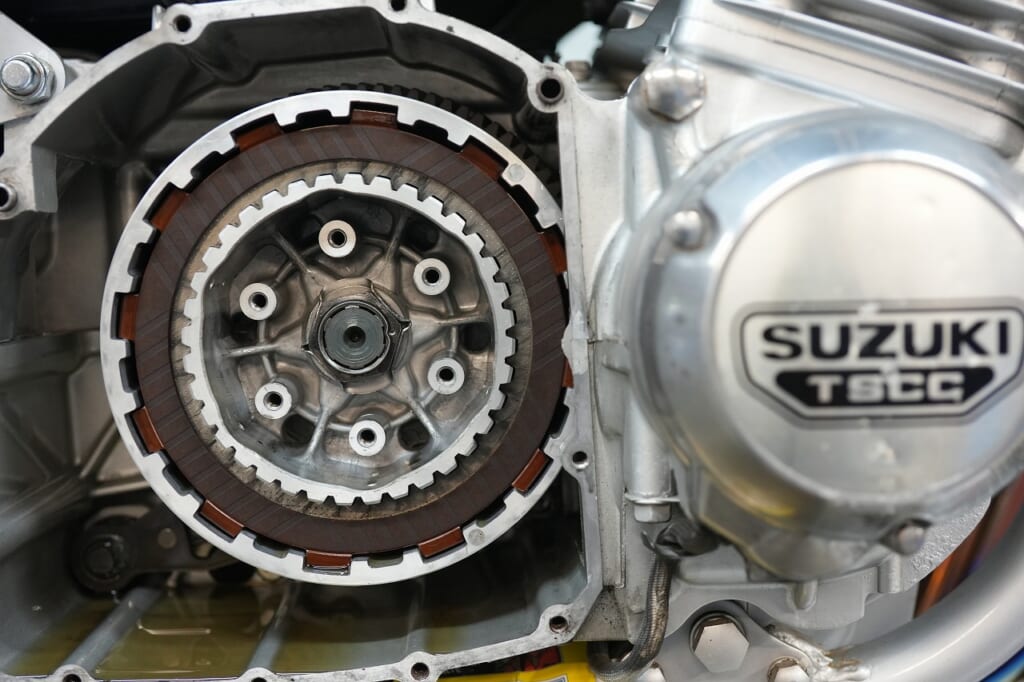
Clutch weight comes from friction and spring
Taken to extremes, if you lower the clutch spring rate or reduce the number of springs, the clutch gets lighter.
Well, that’s obvious! ~Yeah, but when hydraulics and lever ratios come into play, it starts to feel like magic.
But you have to be able to operate within a certain limited range, so it’s tricky.
Examples of subtle changes in master diameter and piston diameter
- Light but won’t fully disengage
- Light but you have to pull the lever all the way to fully disengage
- Engages easily but heavier than stock
I bet a lot of experienced people have run into this?
I think the world tends to write up the benefits in big letters.
“If I just put this master on, my bike will be~” and dreams start expanding, don’t they?
Cable-type also has complex mechanics
- Lever ratio
- Clutch arm length
- Clutch cable length and routing
With both hydraulic and cable, it’s important to properly adjust these to the right position.
Some say if you get used to it, fine-tuning is free…
But just slapping one on doesn’t work—a truly easy-to-use clutch is one that engages fully and cleanly, with an adjustable engagement range.
Finally, a note on hydraulic radial masters
Light and it won’t engage / heavy and it engages —this is a real dilemma.
When it’s light but won’t engage, the lever is super far out.
When it’s heavy but engages, it’s easier to adjust. So we often choose the heavier option.
Which diameter you pick depends on the master and varies by model.
Squeezing it and checking what others say is a good approach.
If you could pick the release, that’d be great, but your choices are limited.
It’s fun to calculate the ratio between release and master and think about it.
But even after calculating… the reality is there are no options.
With the release fixed, something niche like 17.5φ sounds fun too… (oil-cooled)
Since customers don’t understand this kind of master selection, they end up following brands and getting safe, unremarkable results either way.
Was the goal really to improve operability… or to wear a brand… or to make the lever black…
For better or worse, it’s all about spring rate.
You can figure out the load in numbers from the clutch spring rate, preload, and number of springs.
I don’t do it myself, but with modern high-grip friction materials like FCC clutches, reducing preload a bit might be effective too. (subjective)
Why design for 150–160 PS when you only need 120 PS?
Bigger is better. The big covers the small.
That’s the manufacturer’s way of ensuring safe, consistent performance. But what if we reduced the maximum and redirected that to ease the load? Interesting, right?
*Work like this carries risk, so we don’t do it for customers.