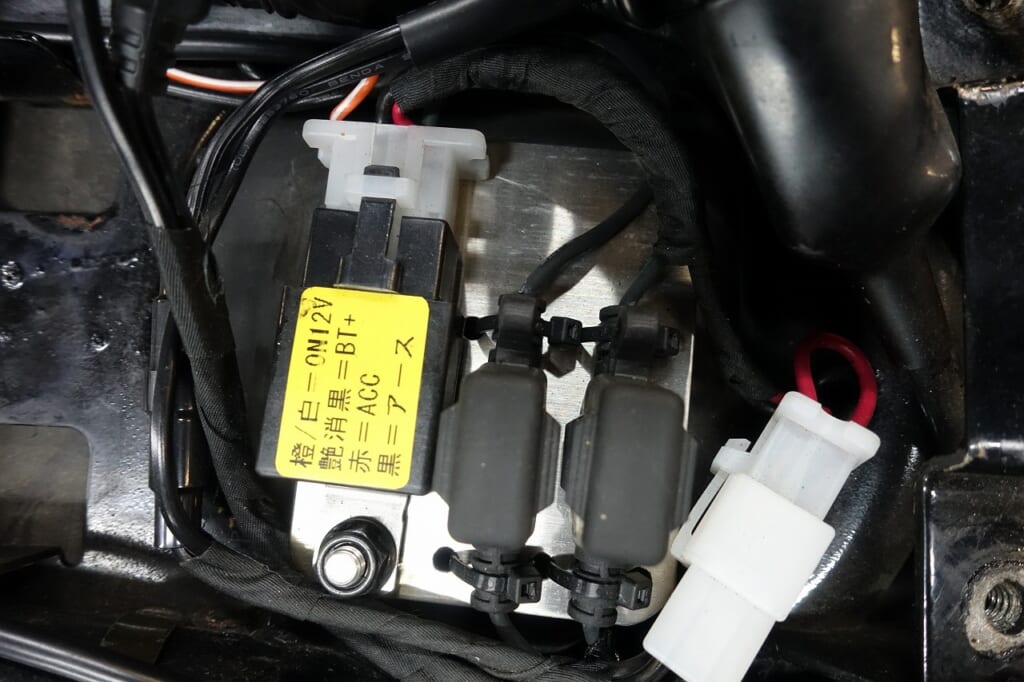
The other day I was working on a customer’s harness replacement.
When I removed the fairing…
Oh! I discovered a nostalgic relic from the past!
In recent years, the installation rate of aftermarket electrical components has increased dramatically.
Not long ago, having just three items like “Yoshimura digital tachometer,” “ETC,” and “headlight relay/HID (is that even a term anymore?)” was considered a lot.
But when you add “USB,” “grip heaters,” and “navigation” on top of that, there are limits to what you can tap from the existing harness.
Even if you try hard to install everything neatly, the appearance can become quite messy, so caution is needed.
You might think, “Really?”
First,
there’s the problem that “tapping power from the same point in so many places looks bad.”
Next,
“the distance to each electrical component varies.” It’s best to keep the power source as close as possible to the electrical components for a cleaner layout, but the ideal location for power and ground isn’t always in a convenient spot.
Furthermore,
“when tapping from the harness, you also need to account for fuse capacity.” Fuse capacity is an unexpectedly common pitfall. Manufacturers usually build in enough capacity that problems rarely occur, but when you add five or six aftermarket systems, capacity issues can arise. And there’s also the possibility of problems from increasing the harness-side fuse capacity just to accommodate aftermarket additions.
The instruction manuals for aftermarket electrical components may not even account for using so many items at once.
One component is fine, but six is probably beyond what they imagined.
Customers who come to us still have carburettor-equipped bikes, so we have some flexibility, but with fuel-injected bikes, that’s not the case.
Power sourcing options are far more limited, and if you try to tap power carelessly, you’ll definitely run into problems.
To wrap up, you can see how convenient and well-designed the Daytona D-UNIT+ really is.
Please take advantage of the long autumn evenings to do the work and get everything sorted out.
Look at this size… ↑ The best I could do with a custom board was fit a relay and two mini fuses.
Because of that size, the mounting location had to be under the tank, which was inadequate layout-wise.
Back then, I played it safe and added fuses, but having constant 12V from the battery flowing under the tank like that… is actually dangerous.
Plus, you end up adding more fuses for that safety, and you need to manage fuse types and locations.
If you can’t quickly identify the type and location, you’ll be completely lost when trouble occurs.
I’m grateful that the Daytona D-UNIT+ came out, but now I have no use for the Motogadget mo-relay units I’d stocked up on (;∀;)
And I’ve got a ton of Honda fuse boxes sitting in inventory too…
Depending on what level of finish you’re aiming for, nothing ever goes smoothly, that’s just how it is.