It’s rainy, isn’t it? Rainy season, huh? (*´艸`)
Now, when it comes to repair and maintenance work where you order the necessary OEM parts and just disassemble and reassemble to finish—that’s really only the case with current models, isn’t it?
Can you get the parts? Can’t you? Do the parts even exist in the first place? Don’t you often find yourself wrestling with these questions right at the parts ordering stage?
It seems like things rarely go smoothly. . . .
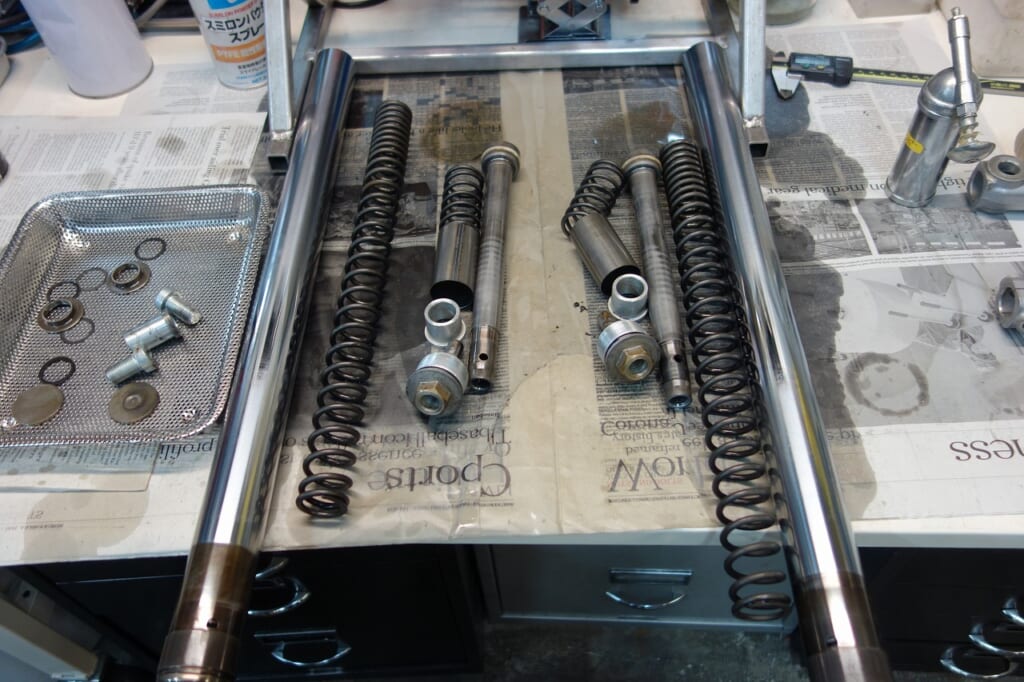
For example, front fork OH
—domestically, it’s basically either Kayaba or Showa.
Oil seals, dust seals, metal, O-rings and such are standard suspension spec parts.
If you know the dimensions, you can substitute even if the original is discontinued.
It’s a good idea to stock physical samples on hand so you don’t fall into the nightmare scenario where parts supply dries up. *Physical samples are stronger than numerical data.
When you’re stuck and suddenly realize it, that becomes invaluable asset data.
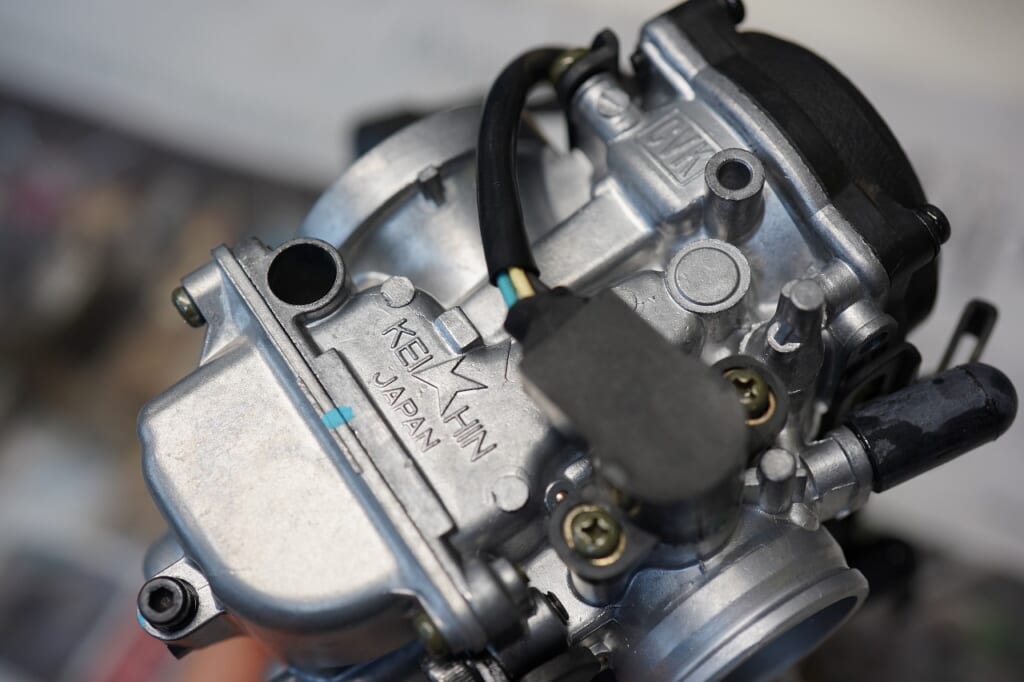
So what about an OEM carburetor?
The parts list has section headings, and to do an OH you pick out and order the necessary parts, then disassemble, clean, and reassemble them to get performance. . . supposedly?
But when you look very, very carefully at the parts list. . . often the parts you really need aren’t supplied.
Seal parts that maintain air-tightness are generally available, but worn blocks, butterflies, felt seals and all sorts of other things aren’t delivered.
Maybe the manufacturer is also saying, don’t use it until it wears out that much. . .
The parts have been used for tens of thousands of kilometers, decades, and worn down considerably—rather than retiring them, using them within a safe range might be better for the machine? Eco-friendly?
It might be easier on the wallet too.
With a front fork, we assemble it with the spirit of making it move as smoothly as possible within tolerance. . .
When assembling, we create a stress-free environment for bolts and mating threads. . .
We bleed air with a vacuum pump to minimize ambiguity. . . .
We look at where the inner tube is wearing and assemble it for longer life. . .
We seal in the secret stuff that makes the oil seal less likely to leak. . . .
And so on—each time we add a little something new. Next time and beyond, we wonder if the work could be easier? Or if things could go even better?
And in that process, we think equipment becomes necessary.
Cleaning tools make a huge difference.
Some things are better cleaned by hand, others can’t be cleaned by hand. Even just cleaning has great depth.
We worry about which detergent is good, which brush is good, and so on.
If work, results, and performance improve even a little from today to tomorrow, tomorrow to the day after, I think everyone’s satisfied?