I used to think that once you reach expert level, you should be able to handle any job accurately and precisely.
But after all, we’re only human.
We slip up, we make mistakes.
If it’s ten out of ten, you’re probably fine,
but achieving a million out of a million is incredibly difficult.
There’s the matter of how you’re feeling on any given day, and the natural decline that comes with age.
Maybe it’s really a game of constantly raising the odds of achieving results reliably without needing skill.
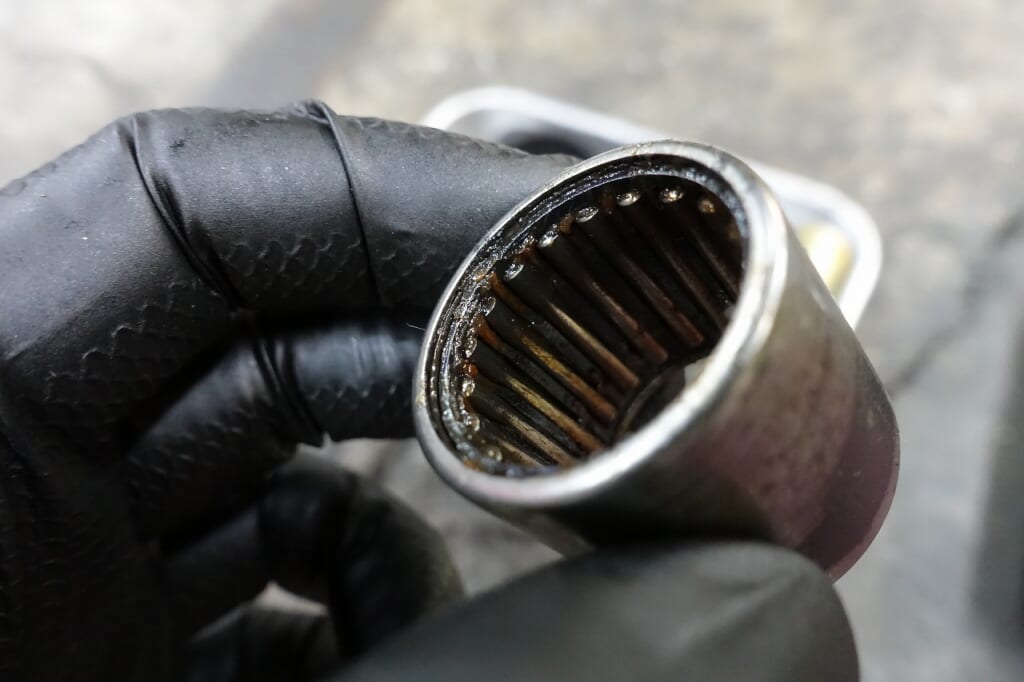
For example, removing and installing bearings—the older you get, the more nervous it makes you.
People who machine bearing press-fit tolerances know the importance of those hundredths of a millimeter.
Probably.
Here we go—bang bang bang—oh no!
When I see work like that, I think to myself, “No, please stop,” and I feel the pain acutely.
I often tell customers,
You can’t tell what’s going on inside just by looking from the outside.
Unless it’s really bad, but…
For example, even when you can feel that a bearing is a bit loose during removal and installation, some people will just pull it out anyway. (Delivery as-is)
If the wheel bearing press-fit is just slightly loose on one side, you won’t notice any symptoms right away.
You only find out when you change the tire or remove the wheel.
But if the wheel bearing isn’t checked during that work, you won’t notice it at all.
In the worst case, years pass and you have no idea when or where the problem started.
There are plenty of situations like that in the world.
To put it bluntly, it’s like playing Old Maid with a deck of cards.
If you draw the bad card, you can just pass it to someone else. I don’t think many motorcycle-loving mechanics have that attitude, but…
What makes bearing removal and installation so difficult is
What does it even mean to pull or push straight?
When you think about what you’re pulling straight relative to, and the design and tolerances of the puller itself, and what reference point you’re using to proceed—it becomes incredibly difficult.
Honestly, it’s not that precise, but I think we should befriend all the various play and tolerances and work to improve reliability.
Make tools that work well for you. That’s the key.
You don’t need brains, sense, or skill—just make something that lets you carry out the work reliably.
Usually, because of time constraints or the order of operations, you end up using whatever’s on hand.
You might even resort to using a box wrench.
If you have a lathe, make something that fits perfectly for that job, and future work becomes so much easier.
Put in the effort once, and not only does the work become more reliable,
but those moments of “Oh no!” will drop dramatically.
It’s just a tool, just a jig, but I believe that building up a collection of things you own and care about leads to reliable work.