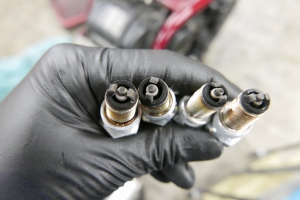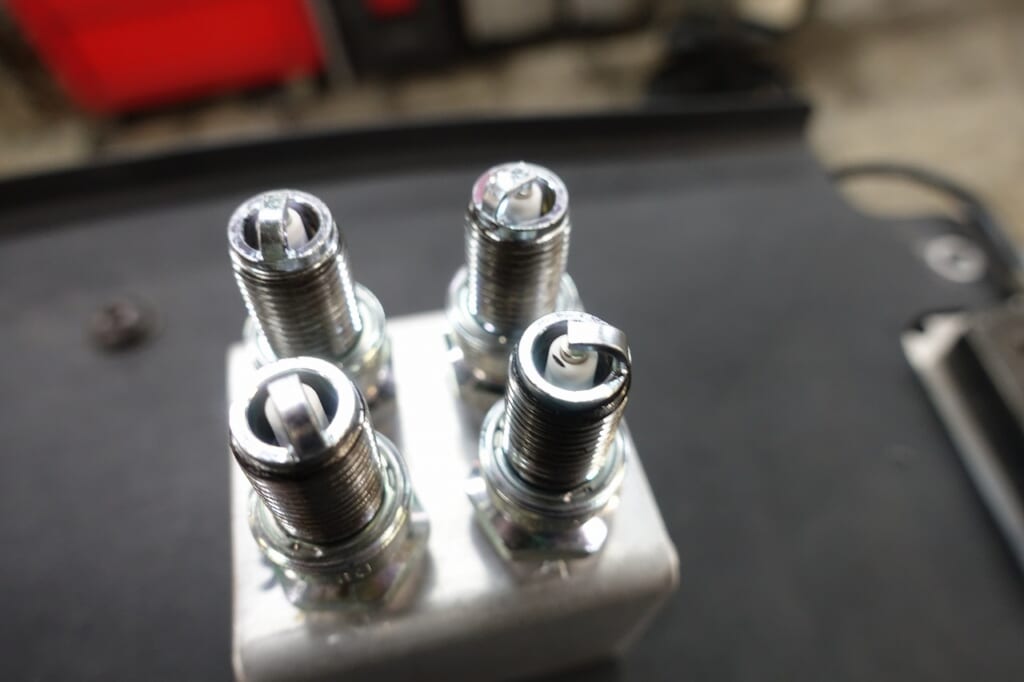
The photo shows a standard resistor plug, but… (*´▽`*)
I understand the feeling—you think it’s a good idea, the price is high, so it must be quality, and you end up grabbing it… Gum spark?
If the engine, carburetor, and ignition are all in good shape, there can be a benefit.
But if you choose iridium thinking it’ll be a game-changer, you might end up regretting it.
(´∀`*) Hehe—the year’s biggest sale, Amazon Prime Day 7/12–13
Iridium plugs are genuinely high-performance (*´▽`*)
Iridium plugs get a lot of criticism.
They really are high-performance, but they do seem a bit sensitive to handling, so I’d like you to be careful.
Just swapping them in won’t unlock their full potential.
In reality, we’d want them to show their full potential just by swapping them in, but…
it depends on the condition of your bike.
Especially with carbureted bikes, you might want to be careful.
If the engine, carburetor, and electrical system aren’t all in good shape, you won’t get the full potential.
If it fouls, that’s it—it might never come back to life (in my experience).
I think there are a lot of people running bikes with poor carburetor condition and poor ignition without servicing them yet. *I might be one of them…
If your bike has those kinds of issues, choosing iridium might be a bad move. You’d be better off going with a standard resistor plug.
In my experience, they seem weak against plug fouling, and once they foul, they’re hard to recover.
With older bikes, the usual suspects are plugs, air filter, and oil, so going with a standard resistor plug is the safe bet—plus it’s cheap and proven ( ゚Д゚).
Heat range matters too ( ゚Д゚).
Heat ranges 7, 8, and 9 are typically what you see on bikes from the ’70s to 2000s.
A 6 range can sometimes be a red flag, but anyway.
Export models sometimes have unusually high heat ranges, but domestic models might actually have the lowest heat range.
Unless you’re revving it hard over 7,000 rpm, you might want to match the domestic heat range.
For street use where you’re not pushing the engine that hard, matching the situation can be good too, and you might get cleaner combustion and lose that raw-fuel smell.
They’re not a fix for poor condition ( ゚Д゚).
Sure, sometimes it’s the plug that’s in bad shape, but honestly, most of the time it’s something else.
They’re not a part you choose to fix your current problems—they’re a part you swap in quietly when everything on the machine is already in good shape, to help it run even better.
I think the image gets ahead of reality sometimes…
Please start by choosing a standard resistor plug.