“Really bad” is easy to spot, but “slightly bad is hard to notice” is the thing.
“Judging an OH is extremely difficult” too.
If you always want “100 points,” just trust time and distance and do the work.
But
street bikes don’t work that way, do they?
I think most people want to use them as long as possible
At most 50,000 kilometers. Beyond that might be risky.
Man, this bike feels heavy…
Haven’t you ever felt that way? I used to feel it too.
“It’s a liter bike after all,” or
“You’re pushing it wrong,” or
“That’s just how it is,” or something like that.
Most people seemed to give an answer like that.
Never gave it a thought? The gritty twentieth century was “If you say something soft like that, you’ll fail,” that kind of world, or so it seemed.
Try applying the brakes lightly and pushing the bike.
Damn, it should be heavy.
That’s “obvious,” but release the brakes and “it feels lighter.”
So…
Is that brake really fully released?
If asked that… you’d probably answer like this.
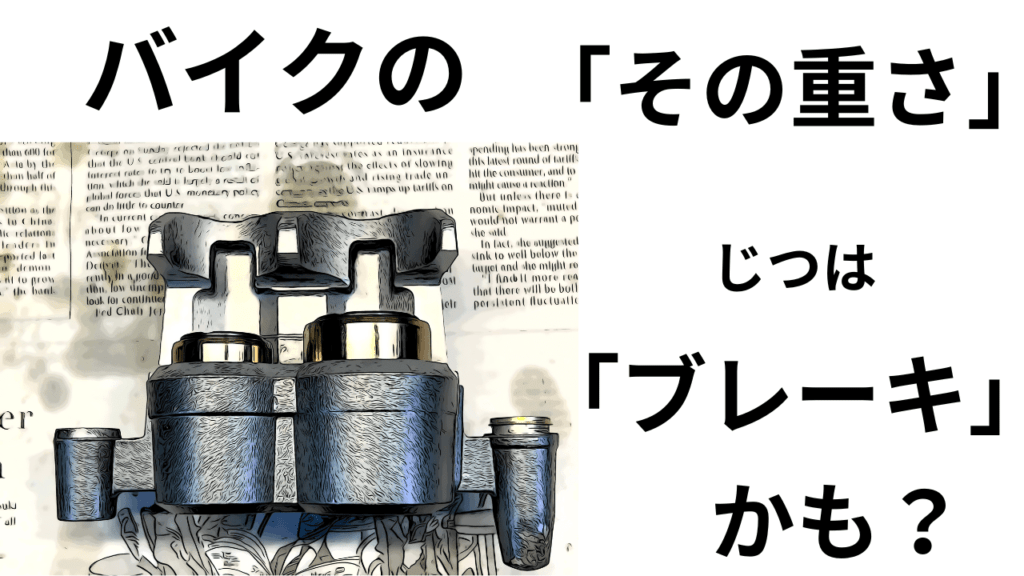
But actually, “it’s actually rare for the brakes to be 100% completely uninvolved in rolling,” I think. Even a little bit is working? There’s friction happening.
Back the pads off a bit and push—it’s “unbelievably light.”
That’s right. It’s something that works in a surprisingly subtle way.
Here I’m only talking about the caliper, but the health of the disc and pads matters too.
The flexibility of the caliper seal affects your bike’s handling, fuel economy, and even suspension operation.
Light without waste is definitely better! (゚Д゚)
Rather than making it lighter in mass with aftermarket parts, “light in a healthy state” is what matters. It’s the same with the human body, I think.
“Good movement feels light,” right?
It gets worse gradually, so you don’t notice.
Japanese bikes are made extremely well.
Generally, major problems are rare.
Because problems are unlikely, “you can just keep using them” for a long time—that’s a downside too.
That’s why maintenance and tracking distance and years of use become necessary.
But it also depends on how you use it, so it’s a tough call.
The same distance—”10,000 kilometers in one year” versus “10,000 kilometers over five years”—is completely different.
“Storage conditions and use environment differ,” but probably “10,000 kilometers in one year” tends to be in better condition.
Strange as it sounds, “a bike that runs” keeps all its parts alive.
When it doesn’t run, “it rusts” and “seals degrade,” and “it gets stiff,” doesn’t it?
Finally: rubber hardens! Do an OH at some point.
While OEM parts are still available. . . .
This doesn’t apply to those of you who are already thinking about swapping out the caliper, but . . . . .