“My Chemical” Series First Edition? Season 1
Until recently I was writing about Makita on my blog every day… but honestly, I got tired of it.
Writing about “things I own”isn’t a burden,but “creating content”is quite challenging.
Ugh~I don’t want to write blog posts~( ;∀;)
I’ve been feeling that way for about half a year or five months…
Well, I’ll do it again.
I want to write about things around me that might be even slightly useful.
This time it’s about “loosening prevention,” “screw lock,” and “fitting”
Since most domestic four-cylinder engines use screw locks infrequently.
Depending on the location,if you read between the lines of “the manufacturer’s intent,”you can
understand the usage“feasibility”of each part.
“Prone to loosening” “Would be a problem if it came off”
Basically it would be a problem if it came off… but I don’t mind if one cowl screw flies off.
The same goes for brake calipers, steps, and handlebar areas.
Basically,“as long as it’s tightened properly, it’s fine.”If you use screw lock on everything, removal and unscrewing become difficult.
That’s what makes it subtly tricky…
Areas with “ON/OFF” or “moving back and forth” require caution
Power transmission areas have a structure prone to loosening.
The action of starting and stopping induces loosening.
Even though bolts and nuts are fixed,
“the mating part can move by the tolerance amount,”which is why this happens.
“Clutch center nut, drive sprocket, rear sprocket”
require special attention.
Brake discs are similar but not as critical as the transmission system.
Bikes basically don’t go in reverse.
Depending on“what kind of force is applied to that location and how frequently it’s accessed,”
you can adjust the strength accordingly.
The application location is also important
For loosening prevention insurance,“the exit side of the thread”is sufficient.
Conversely,“it not coming off”is risky.
If applied near the exit side, you can also“weaken the screw lock with heat.”If worst comes to worst and you need to use
“drill drilling + extractor,”the difficulty decreases.
Using high strength on everything is quite risky.
Causes of loosening and physical locks
If you carefully observe and think about the causes of loosening, it’s often surprisingly simple.
Usually it’s“twisting force”or“sliding in the loosening direction”or“non-floating”
structural issues.
If you just need to prevent parts from falling off,
“lock nuts,” “cotter pins/β pins,” “wire rings”
and similar solutions are simpler and have less risk and workability issues.
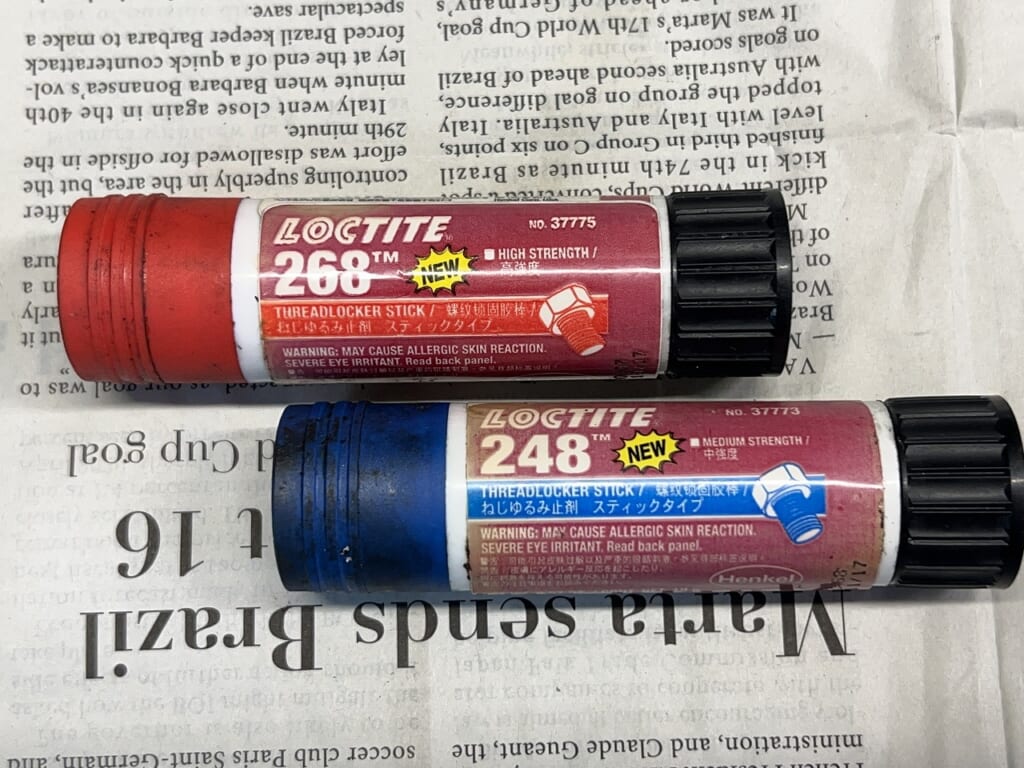
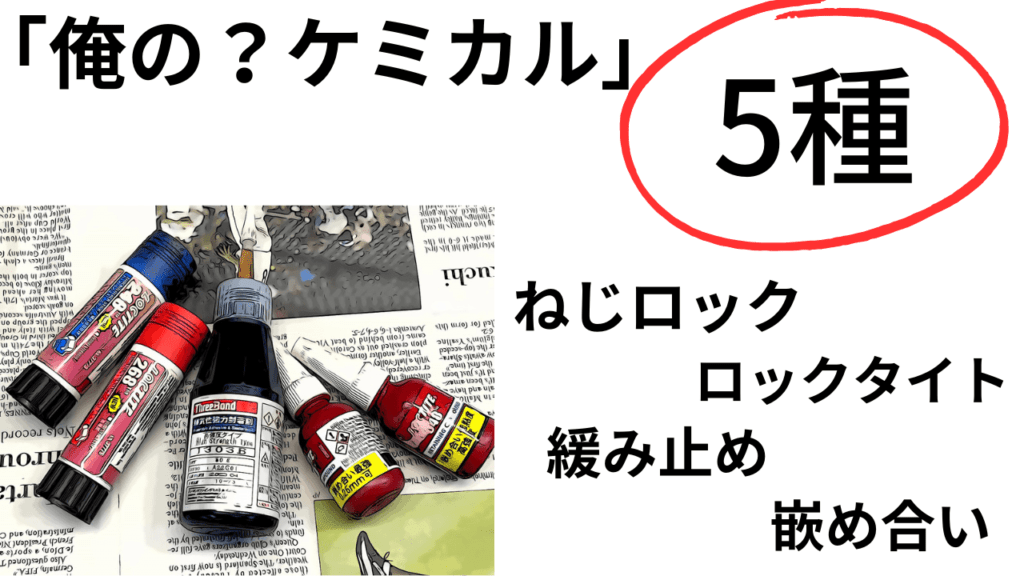
Loctite Lip Type 248 and 268
Loctite 248 Medium strength
Loctite 268 High strength
Being solid,“it doesn’t drip,”which is an advantage.
It has its place depending on the situation.
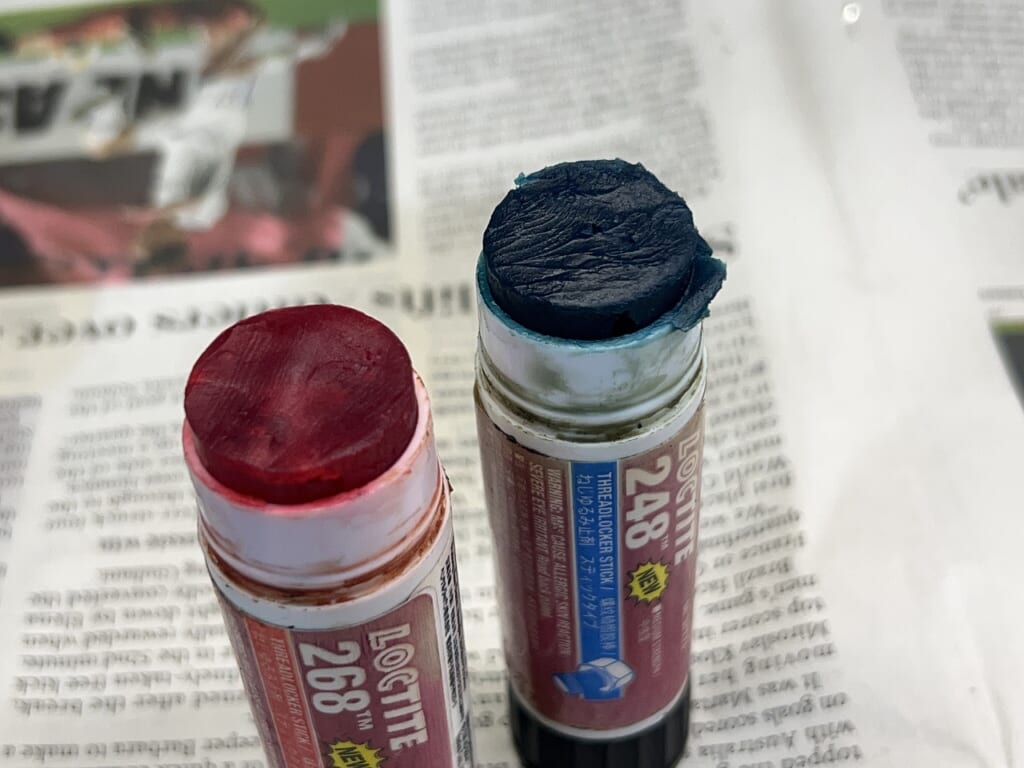
This wonderful stuff comes out when you twist it(*´ω`*)
Honestly, a lip balm-sized amount is sufficient.
Basically, choose small portions for chemicals.
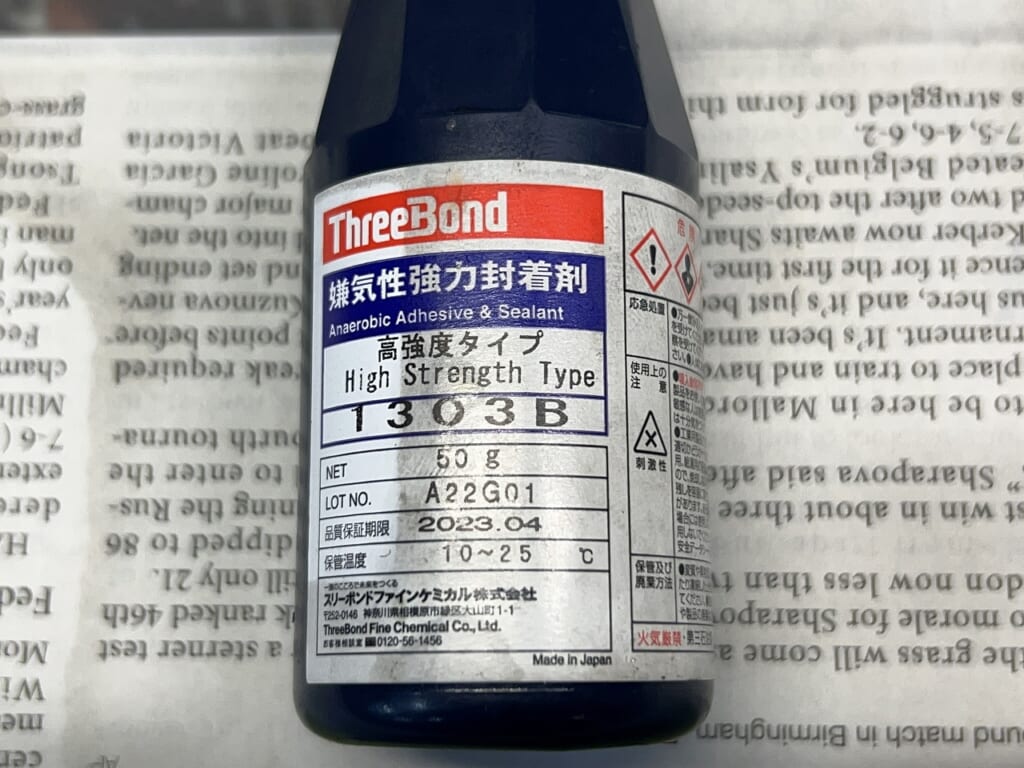
For liquid, just one bottle of Threebond 1303B.
I only use this one liquid type.
The amount you use on the bolt affects how well it works.
Whether it’s risky or notis all about judgment.
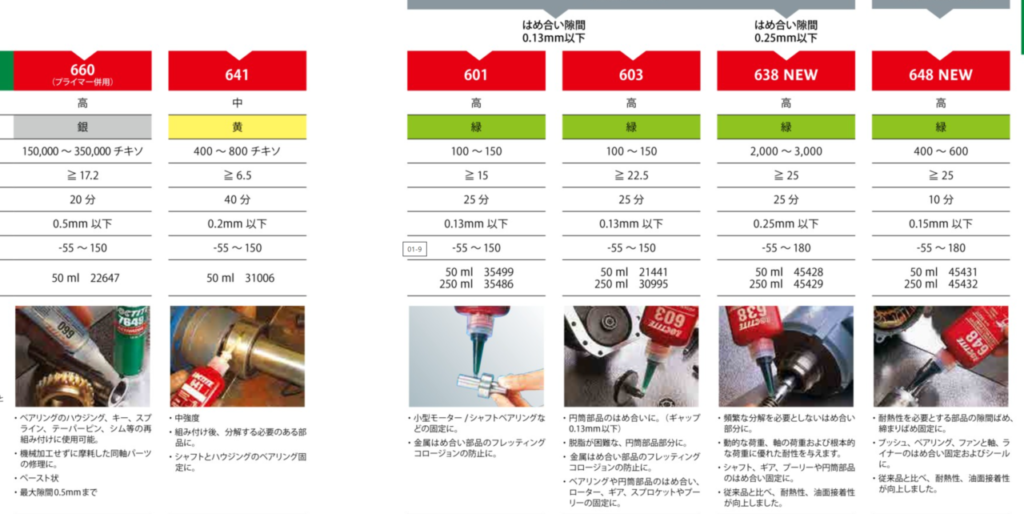
The rarely-used but super important “fitting” series
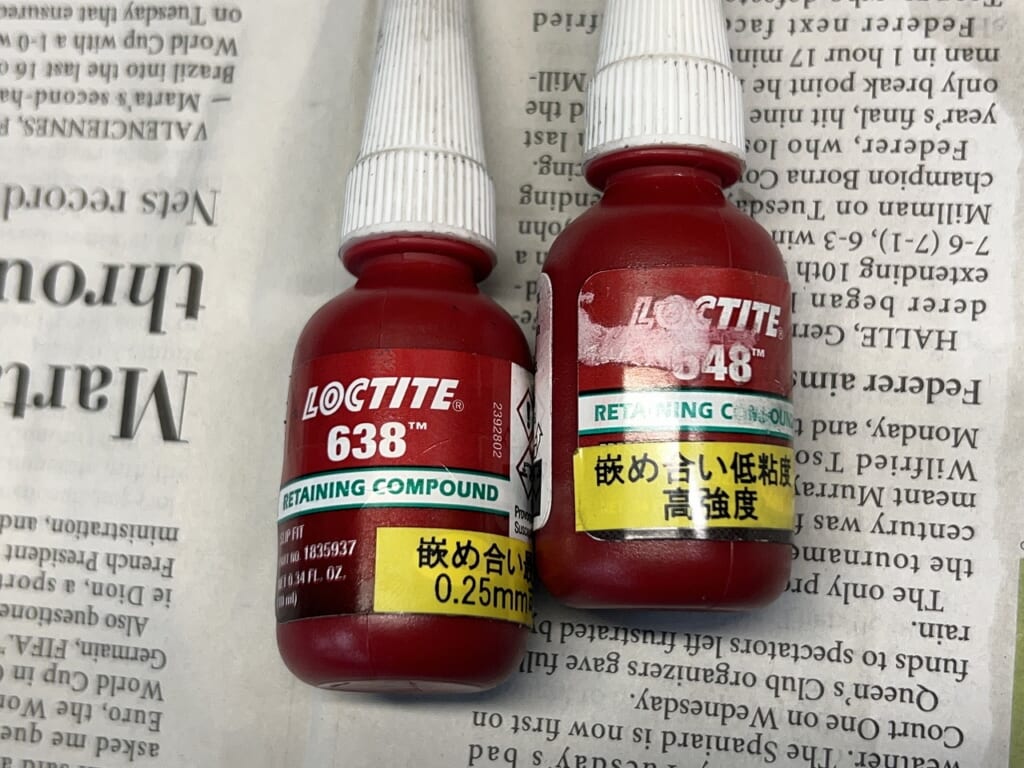
The “dangerous one” in Loctite history
It’s used for fitting.
Generally there’s no need for it, but you use it when you’re in trouble.
“Bearing press fit is loose”
If you spend money, a master machinist can somehow handle it, but…
For this wheel, that’s not really…
Until I find a replacement used one…
Until the Magtan arrives…
I want to think about it a bit…
That kind of situation, right?
That’s when“the power of science comes into play.”
It’s really quite dangerous…
They become firmly integrated, so be careful.
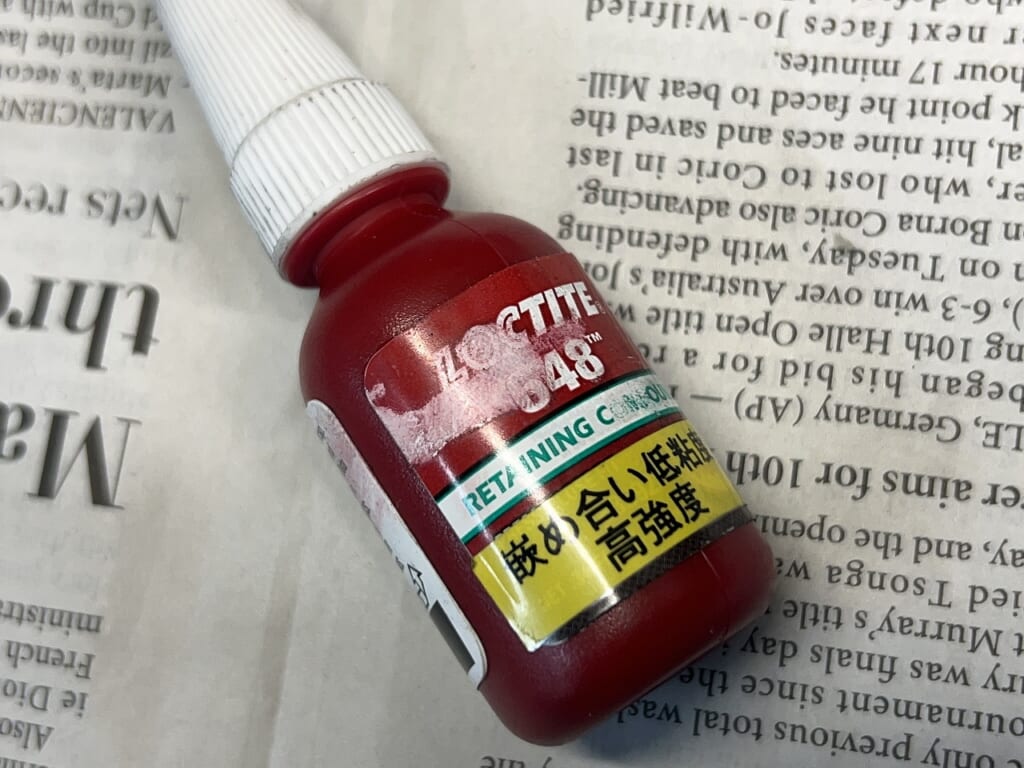
Self-proclaimed high-strength (I’m strong) Loctite 648
It’s a nice product with a smooth, runny consistency that’s easy to use.
Even your worried feelings“become smooth”and solidify.
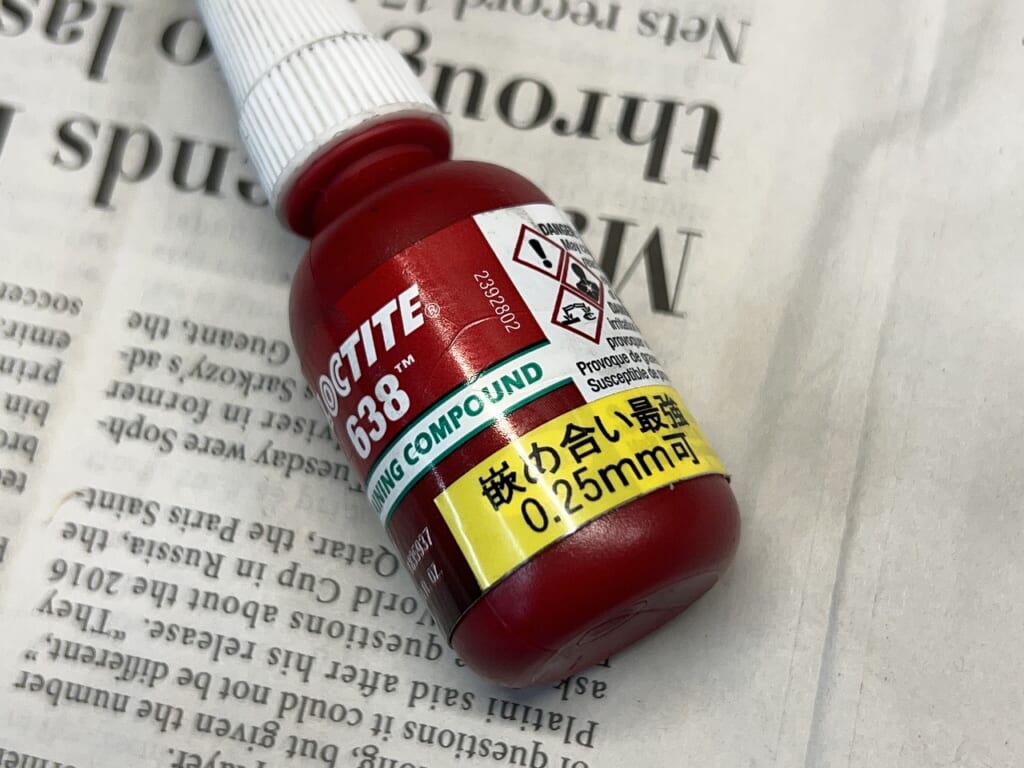
Really? Possible up to 0.25mm. Loctite 638
Is it really possible up to 0.25mm?
Don’t say things like “doesn’t it lean to one side?” Dream big.
0.25mm is sloppy. Really sloppy.
I’ve never used it on such sloppiness so I don’t know…
But it must be fine.
The demon requiring primer! 0.5MM 660 also exists
That’s how I introduced five types.
Use screw lock as needed, understanding the right application and dosage.
That’s the hardest part, so there’s a tendency to use too much, but…
Try to prevent problems from occurring.
Especially be careful with “easily stripped heads”
“Button head/+”is quite dangerous.
Bolts with a smaller wrench size than the bolt diameter
*M10 with“10MM wrench”or M8 with“8MM wrench”and materials like titanium or SUS
A bolt that should take tens of seconds to remove taking hours is a real problem…
(;・∀・)Here are the screw locks I introduced.


 ポチップ
ポチップ
Perfect for your first bottle
 ポチップ
ポチップ
Even higher strength

It doesn’t have to be Threebond.
 ポチップ
ポチップ
This one if the fitting has become loose?
 ポチップ
ポチップ
Heat resistant and 0.25MM becomes integrated?
 ポチップ
ポチップ