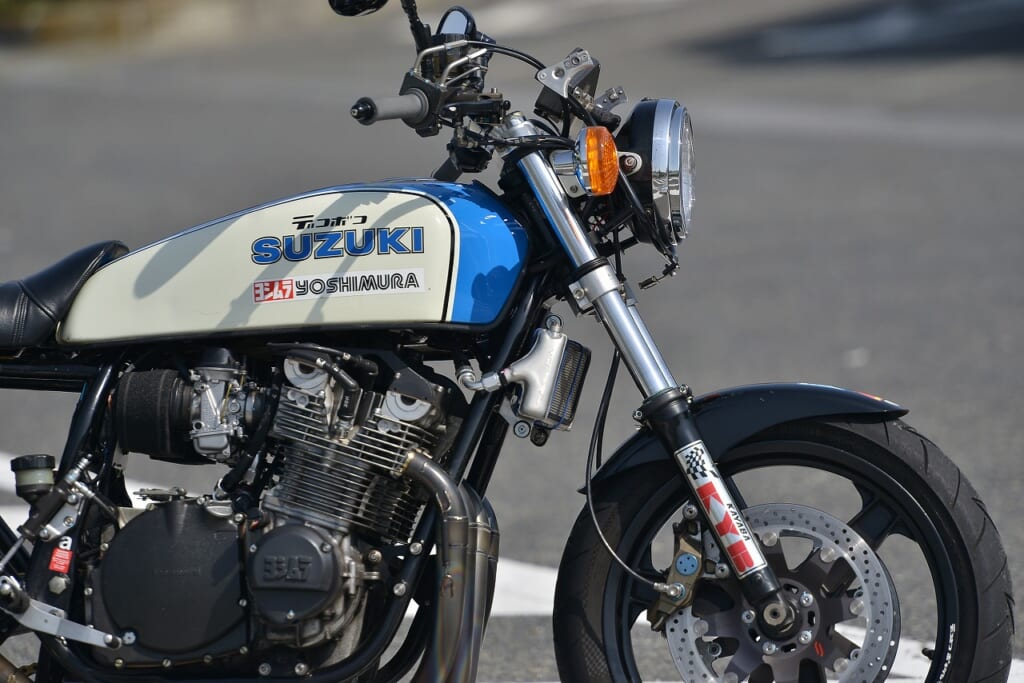
Personally, I’d overwhelmingly push for the GS… that’s the thing.
It’s such high quality, but is it because it’s Suzuki? Because it doesn’t share parts with the domestic GS750?
If you’re going to ride it for a long time, I really think the Z is the way to go.
Is there a difference as big as VHS and Betamax?
I haven’t looked up the actual numbers, so I can’t say for sure, but from what I can tell, there does seem to be a difference about as big as VHS and Betamax.
I actually have a feeling there’s even more of a gap.
Naturally, the volume delivered to countries around the world is completely different. The number of OEM parts is the same story.
Thanks to that, even now reproduction parts are abundant and seem to get upgraded year after year.
There’s a reality here where you can’t compete with the sheer volume of the larger market.
The isolated GS1000 and GS750
By the way, the 750 and 1000 are barely compatible at all.
They look similar, but they’re so different you could say they’re completely different machines.
No compatibility means weak parts availability, so you end up in trouble over something as simple as a gasket.
The engine situation is pretty serious.
When we do an OH, our approach is to reuse what we can and understand what we’re using.
For example, the transmission is a wear item that exists in a husband-and-wife relationship between the driven and drive gears.
What do you do if the 2-3 speed, which gets used most often, is in bad shape?
What if the shift fork is all burned up?
Of course, the front and rear cam chain slippers are also hard as ceramic.
The top-end issues seem manageable these days, but the bottom-end problems are really troublesome.
The strength of reproduction parts
The Z has so many options available, even for something as simple as bodywork.
From ordering to arrival and completion is fast, so recovery from an accident is easier.
For example, if there are no reproduction or used parts available…
If it’s a tank, you somehow restore it and reuse it. It takes time.
I think you need at least one spare set. Even just putting something back the way it was is a hassle, and you might end up in a situation where there’s just no way forward.
With a Z, you can choose from many options on eBay, Yahoo Auctions, or reproductions.
With a GS, you have to compromise and choose from a limited selection.
Is the GSX1100S still good?
It’s a bike famous enough to be listed in Japan’s classic motorcycle catalog.
It doesn’t match the Z, but reproduction parts are being delivered from various sources, so that helps.
I think it’s supported by the enthusiasm of the manufacturers and sellers who make and sell these parts.
What about the GS?
The engine design is extremely simple. The 750 has a cam chain idler, but the 1000 doesn’t. (The GS1000R XR69 does have an idler.)
The aluminum quality is also very high—you don’t have the helicoil worries you get with the Z.
It’s an engine with very few complications when it comes to disassembly and reassembly.
The frame is also very simple with no weird gimmicks.
An air-cooled four-cylinder that came out after the fact, and it really is a beautifully finished bike.
However, considering the number of examples out there and the reproduction parts situation, I think it’s a bike that’s a bit difficult to maintain unless the owner has really high enthusiasm.
If you find an example in good condition with a known history, I think it’s an air-cooled four-cylinder worth experiencing.
How about as your last bike in life? (/ω)