With older bikes, replace it first, and then you should know where it is.
What?You don’t know where the fuse is? . . . .
Well, I guess it’s okay. We have a tow truck anyway, and it’s a problem once it blows.
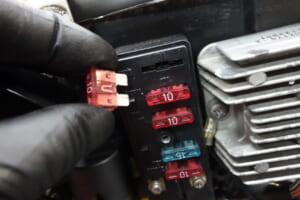
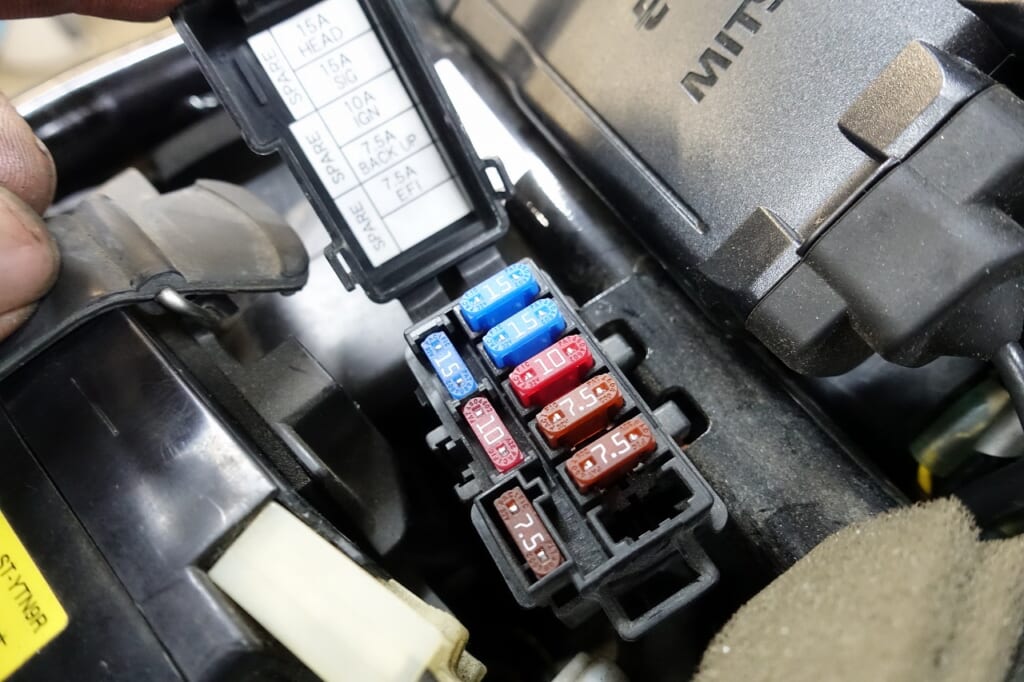
A sealed compartmentis what it usually is.
Where is it?Just knowing makes a difference.
Japanese bikes are great! There’s little to complain about with the electrical system.
Honestly,you rarely experience a blown fuse, do you?
When it does blow, it’s usuallyaftermarket parts that are the culprit, I think.
But just in case something does happen,you should at least knowwhere the fuse is.
Even bikes with the worst access?
To access the fuse,you need tools?Some bikes
require you to remove this and thatbefore you can get to it
surprisinglycommon.I think it’s good to check the location once beforehand.
Probably can’t remove the fuse.
In the worst case, a fuse that hasn’t been touchedfor over ten yearsis difficult to removeeven by hand.
When the time comes,you don’t know where it is,and even if you can access it,you can’t remove it—you can imagine such a situation, right?
Can’t see it because of presbyopia?
A standard blade fuse would be visible,but mini or low-profile ones—I wonder if you can see those . . .
That’s what I think.
Your chances of making it home increase
If you can replace the fuse,you might be able to ride home without waiting for a tow truck,ormove to a safer location—your chances improve.
You won’t always break down on a sunny, pleasant, empty road.
If you stop in the Yamote Tunnel,it’s the worst.You’d do anything to get out. . . . .
An ounce of prevention is worth a pound of cure—that’s what the wise people of old used to say.