I have so many things I want to do that I’m overwhelmingly short on time……! But more than that, the excitement never stops every day(‘;’) These past few days I’ve been in a frenzy preparing for the sudden arrival of “chickens.” It’s a completely unknown new genre, so I’m enjoying it like a kid.
I’m frantically studying by watching YouTube videos one after another, but overseas DIY chicken coops have simpler structures and are surprisingly more rational than Japanese information. Above all, they’re clean, stylish, and seem easier to manage. Japanese breeding methods tend to focus on “how to do it as cheaply as possible (cost-effectiveness)” which is the impression I get.
If all goes well, I should be able to bring them home as early as this week or next week! I’d love for them to devour all the crickets crawling around in my yard as a full belly treat (laugh).
I often tell people around me, “the time you can truly play freely in life is surprisingly short.” While values differ from person to person, I think being honest with your curiosity and using time wisely is the secret to making life as interesting as possible(´ω`)
Today’s beloved garage life: metal longevity chemical log
Today’s theme:The logic and real-world application of “rust converter,” which chemically inactivates the old bike curse of “red rust”
The decisive difference between red rust and black rust:
Red rust (ferric oxide): A porous, hollow structure that absorbs moisture and oxygen, spreading corrosion endlessly into the interior—the “cancer of metal.”
Black rust (ferroferric oxide / magnetite): Forms an extremely dense and hard protective film that physically shuts out outside air and moisture, stopping corrosion dead in its tracks—a “guardian membrane.”
Decoboco’s approach to rust conversion:
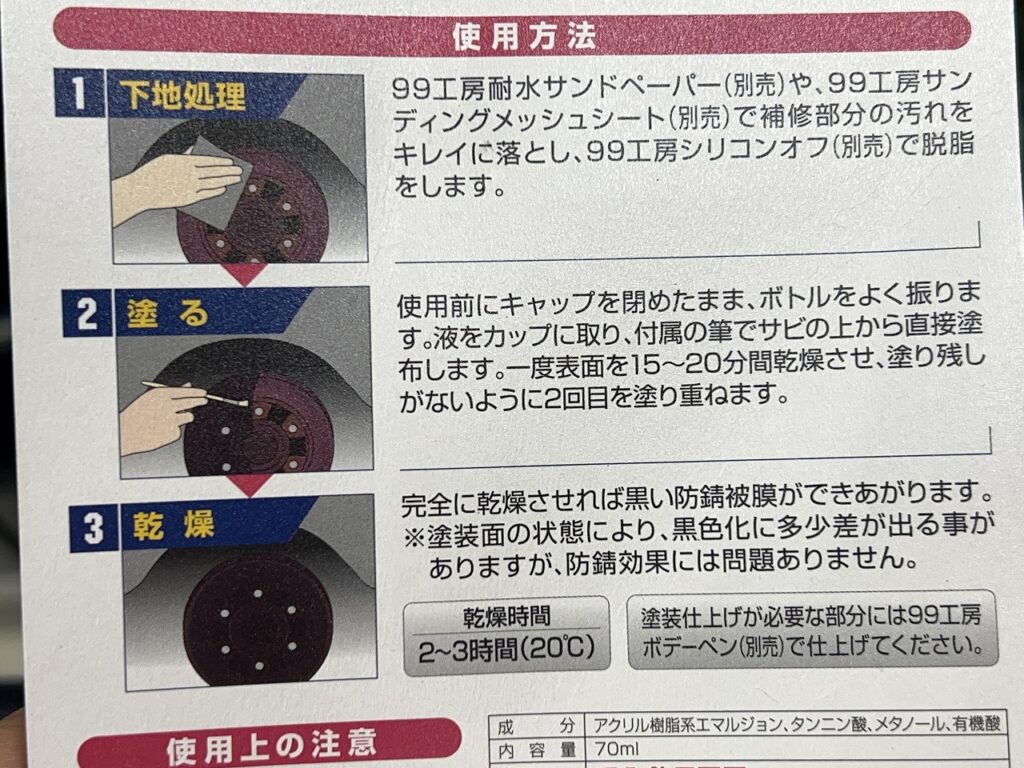
“Pre-coating surface prep” is 90 percent of the job: Remove the thick, flaking “loose rust” with a wire brush or Scotch pad, and completely degrease. Painting over loose rust won’t stick!
Complete drying of the chemical reaction: Discern the process where tannic acid or chelating compounds react with iron ions, chemically transforming from reddish-brown to jet-black insoluble film.
Ensuring adhesion with final rust-prevention coating: Wipe away excess reaction residue and build a substrate for topcoat paint or rust-prevention wax to adhere to.
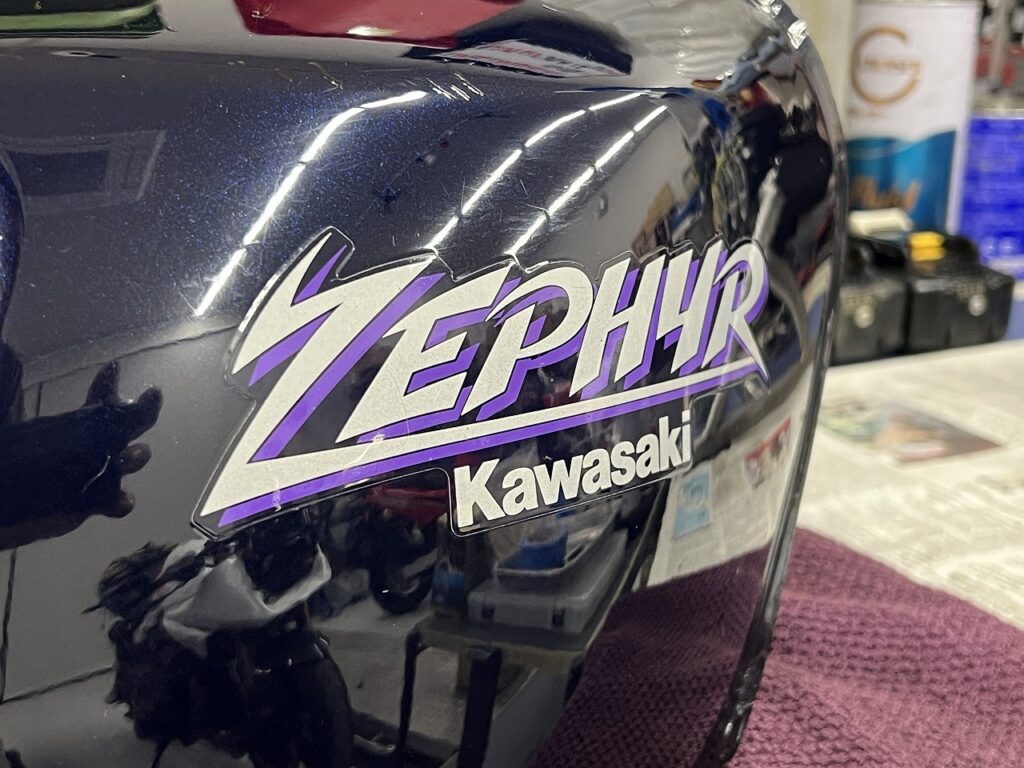
Shop owner’s note: Where simply grinding away would thin the iron, we use chemistry to make rust our ally. This is the foundational tuning to protect the skeleton of my beloved original-bodied Zephyr 550 for decades to come!
Hey Gemini! Honestly, what’s the deal with rust converters?
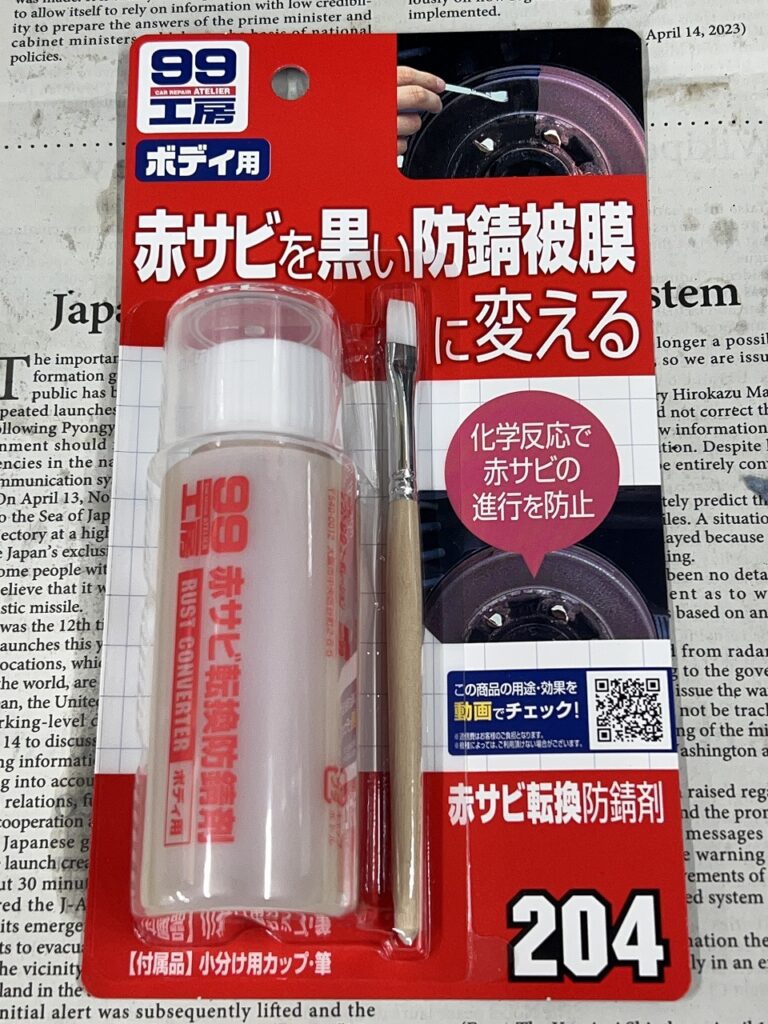
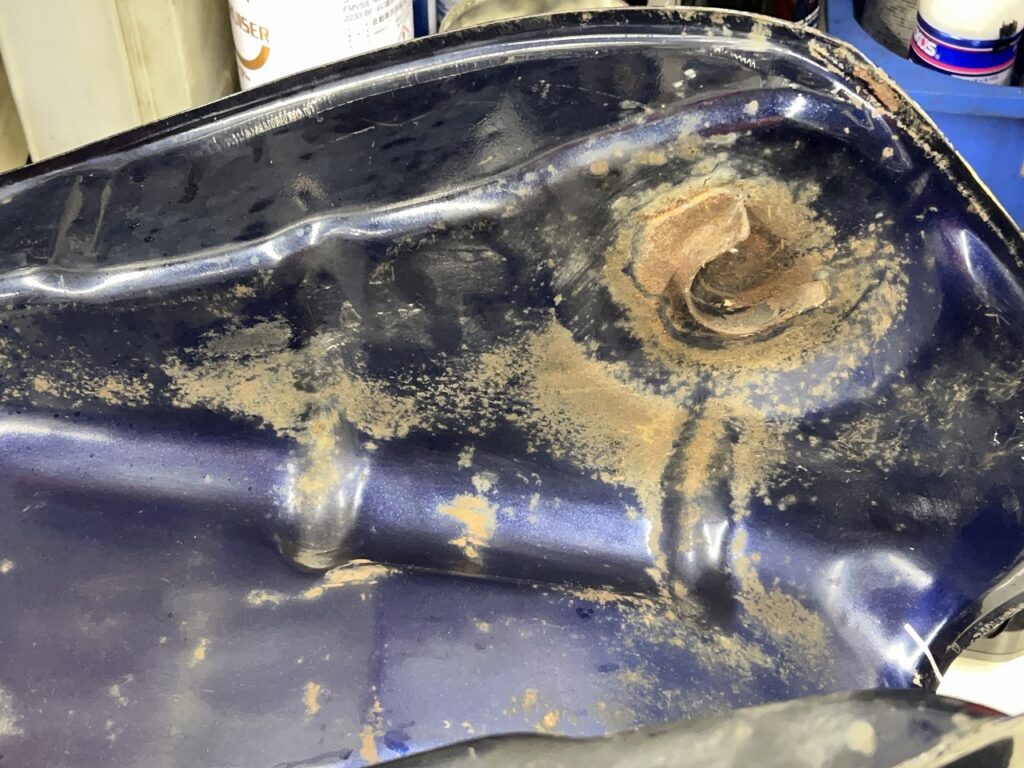
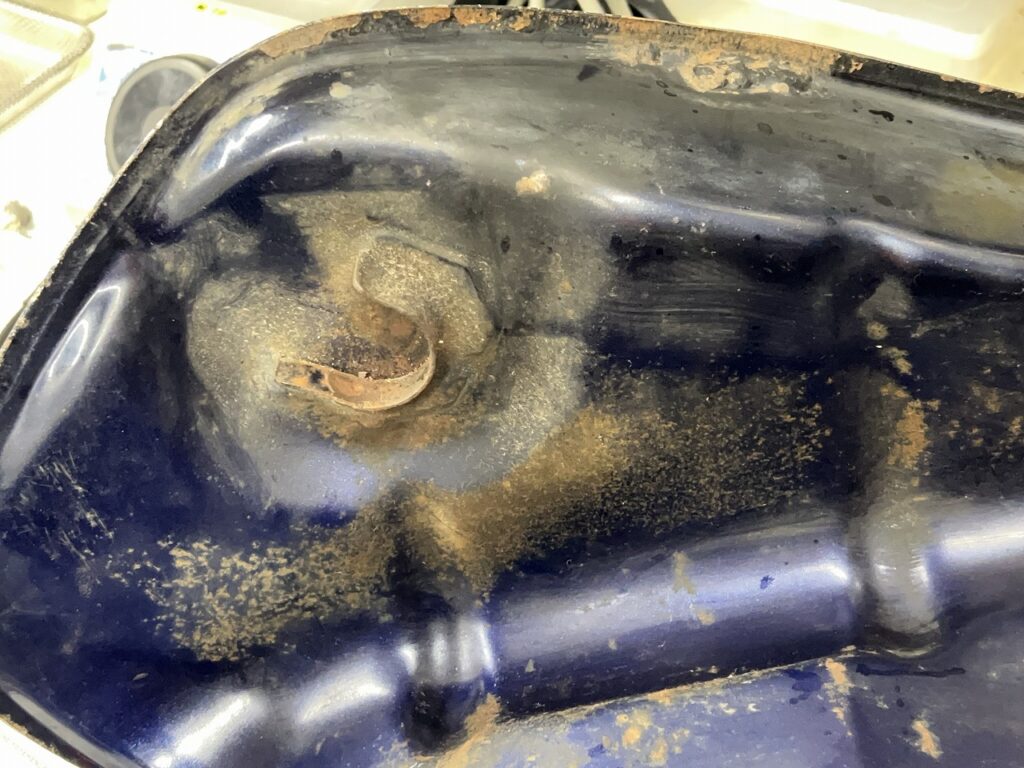
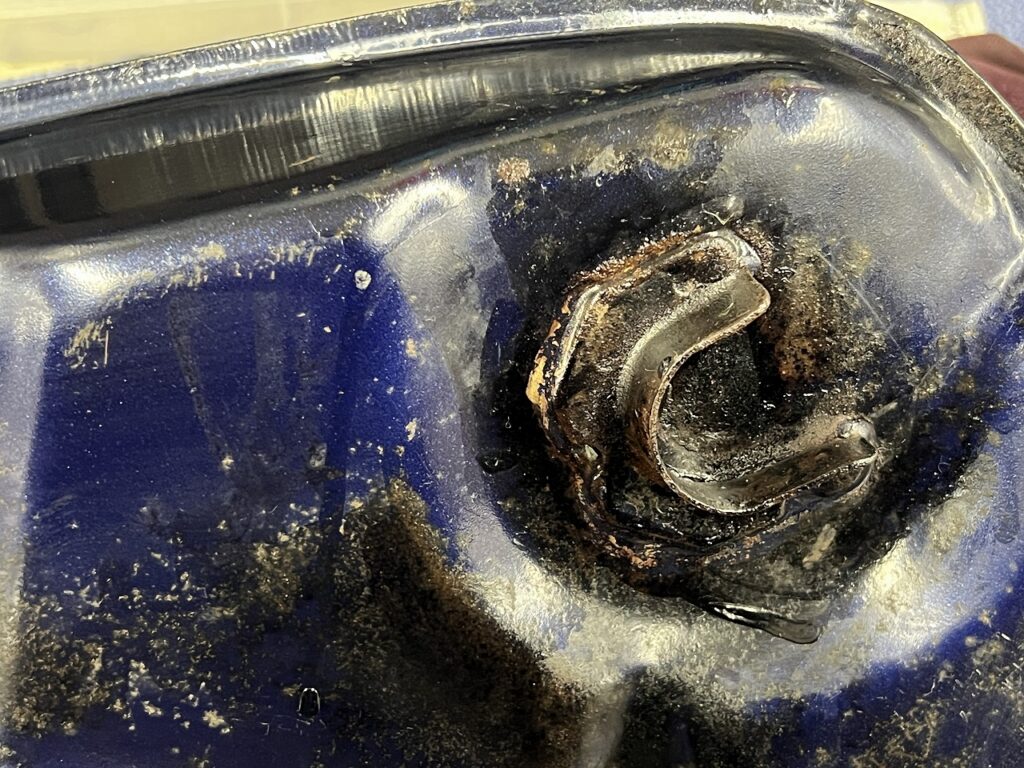
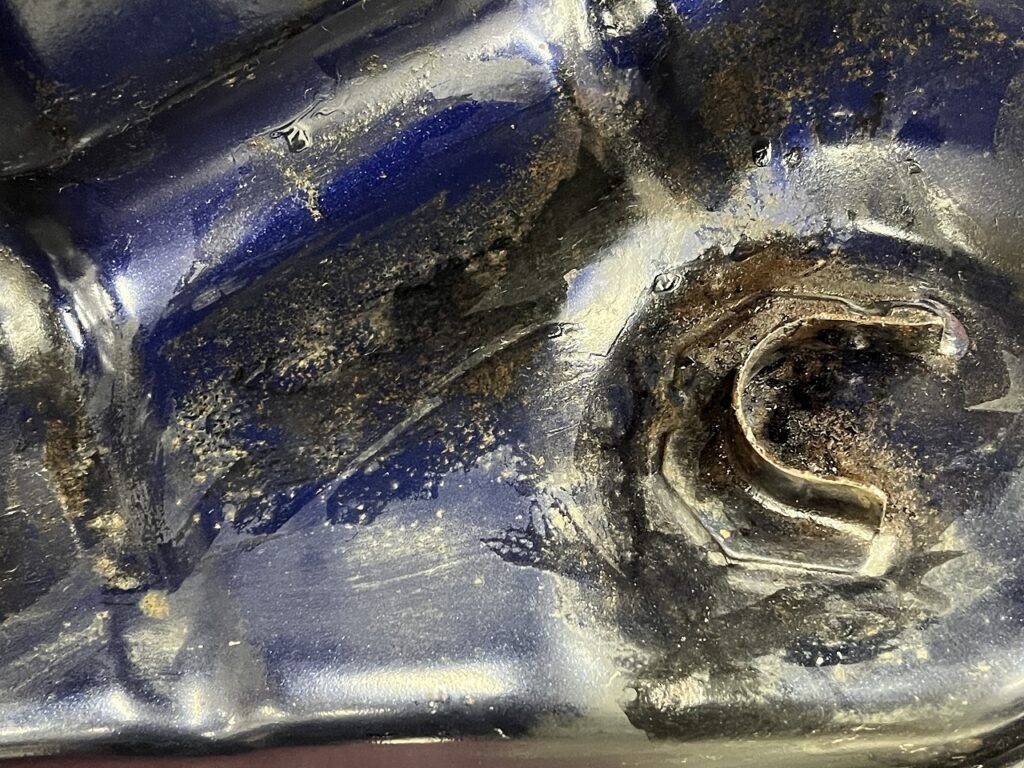
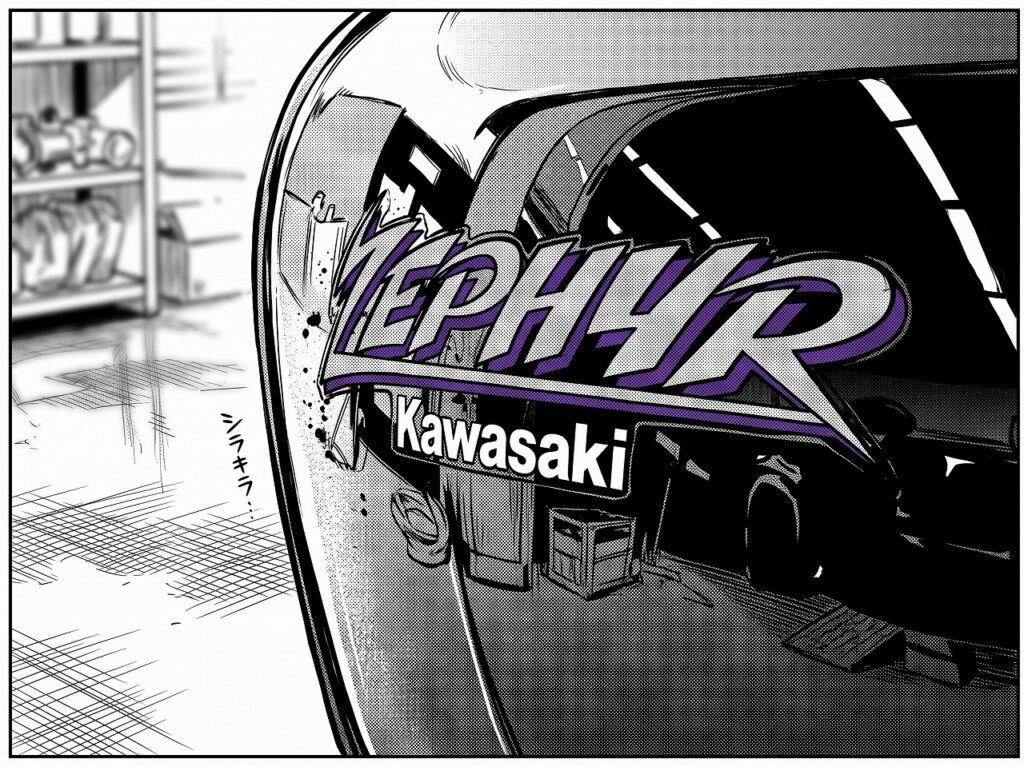
The tank underside was subtly rusted, so I picked one up. I could have masked it and just done a light wet-blast and paint on the tank underside alone, but… that would be kind of half-baked too.
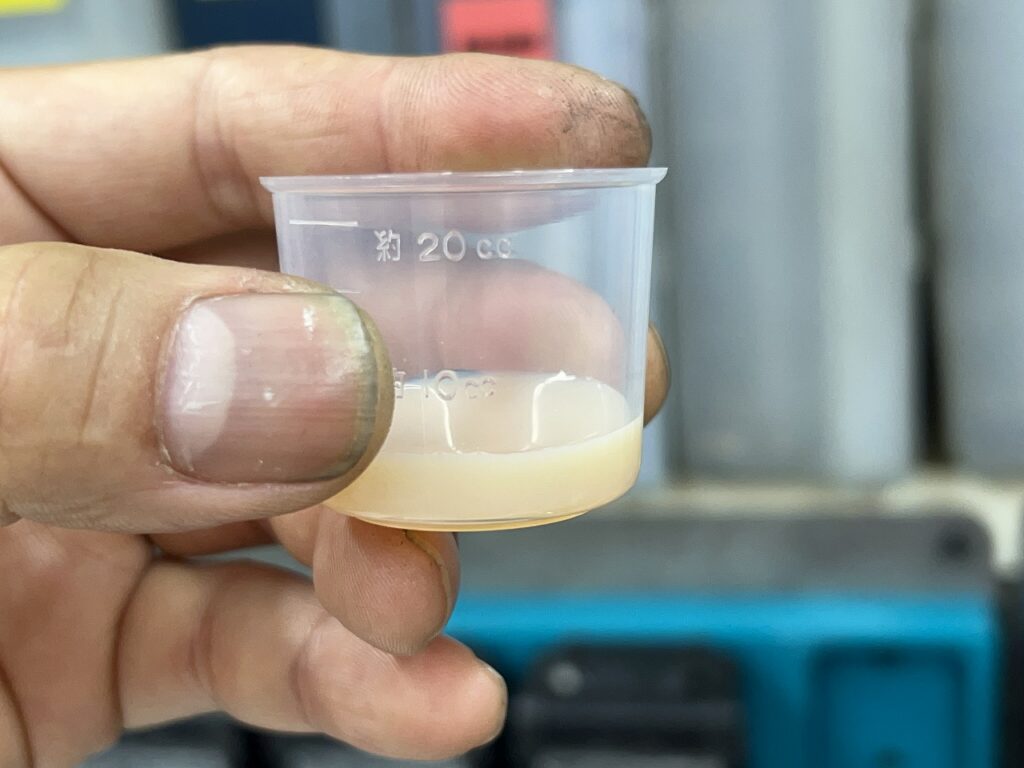
It’s kind of like Yakult colored. It’s surprisingly thin.
Black rust converter logic and effects
Black rust converter (rust converter) is a chemical that performs “chemical reaction-based neutralization and inactivation” and “complete oxygen and moisture blocking via high-molecular polymer” simultaneously on red rust that is difficult to remove physically.
1. Basic logic of black rust converter (mechanism)
The main components consist primarily of “chelating agent (tannic acid, etc.) + acid catalyst (phosphoric acid, etc.) + water-based emulsion resin (acrylic/latex type),” and after application, a two-stage process proceeds.
① Chemical reaction phase (red rust inactivation)
Red rust characteristics:Red rust (iron oxyhydroxide $FeO(OH)$ or ferric oxide $Fe_2O_3$) has a porous, hollow structure that readily absorbs moisture and oxygen, and self-catalytically advances corrosion deep into the iron.
Reaction mechanism:When the converter is applied, trace acid (phosphoric acid, etc.) slightly dissolves and activates the red rust surface. There, polyphenols like tannic acid act strongly, forming chelate complexes (tannic iron complexes) that bond firmly with iron ions ($Fe^{3+}$). This is the reaction that visually turns jet-black. Because this complex is extremely insoluble in water and has a dense crystal structure, it fixes red rust into “an inert black film that will no longer react.”
② Physical barrier phase (sealing via resin emulsion)
As the acrylic/styrene emulsion resin base of the liquid dries, it forms a dense, continuous high-molecular coating film.
The layer converted to black is completely sealed from above by resin, physically blocking the “oxygen” and “moisture (water vapor)” necessary for rust progression.
This resin layer functions directly as a primer (substrate barrier) for topcoat paint (lacquer, urethane, etc.).
2. Effects and benefits obtained
Labor savings on rust removal (chipping)In recessed areas where wire brushes or sandpaper can’t reach, at spot-weld seams, in casting voids—areas where complete removal is impossible—you can halt rust progression.
No loss of sound base metalUnlike grinding, you avoid thinning the parent iron.
Paint primer adhesionThe dried resin film exhibits moderate anchor effect and shows good adhesion to most topcoat paints.
3. Precautions for achieving effects (limitations and drawbacks)
Ineffective on loose rust and mill scale (black oxide)If you apply it over thick, flaking red rust (flake-type rust) that peels off in layers, the liquid won’t penetrate deep, and the rust layer will peel off bit by bit. You must first remove loose rust and debris with a wire brush.
Difficult to react with “bare iron”Because it reacts with iron ions in red rust, applying it to clean, rust-free bare metal won’t turn black—it just leaves a thin resin film.
Heat and solvent resistance limitsUnlike high-temperature heat-treated cast iron (pure magnetite film), the barrier’s main component is organic resin,so it can’t be used on high-temperature areas like exhaust pipes (typical heat resistance is only 80–120°C). Also, if you rub it with strong lacquer thinner or acetone right after drying, the resin dissolves.
Summary
The essence of black rust converter is “a hybrid method that converts red rust into an insoluble stable chelate compound while simultaneously sealing it with high-molecular resin like a vacuum pack.”
It’s not a magic potion that completely eliminates red rust; rather, it’s a substrate-prep chemical that “chemically and physically halts the activity of microscopic red rust that can’t be completely removed, sealing it beneath the paint film.”
But honestly? What’s the real story?
It’s in pretty sad shape like this( ;∀;)It’s progressing and I can’t just leave it…
This is how it turns out. …I’m seriously regretting how sloppily I spread it (laugh).
Once dry, I thought the stains would blend in smoothly, but since it’s the type that “seals and caulks the surface with resin emulsion,” it leaves a glossy “looks like I just applied some chemical” finish. Since the resin film barrier will peel off from UV or rubbing and red rust will naturally recur, think of it as a two-stage approach: “chemically convert red rust to black rust while sealing the surface with a resin coat.”
As for use cases, it’s for pinpoint situations like “I don’t want rust erosion to progress any further” or “rust prevention in recessed, hard-to-reach areas where blasting or polishing won’t reach.” It’s different from the pure black rust (magnetite) film created by high-temperature firing like cast iron, so don’t expect excessive durability.
That said, it’s perfect for when you “don’t want to go through full-scale painting, but just want to stop rust progression for now.” …But when asked “so where would you use this on a bike?” honestly, nothing comes to mind right away (laugh).



 ポチップ
ポチップ