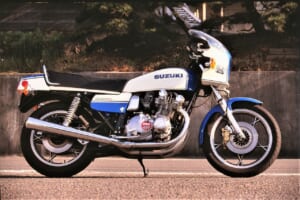
I want to ride a bike like the legendary models you see in catalogs . . .
Z, CB, Katana and so on . . . there’s quite a selection, right?
When you think about price, condition, storage, and maintenance, your options become somewhat limited.
The most important thing might be passion! (*’ω’*)
Don’t have unrealistic expectations for a 40–50 year old bike ( ゚Д゚)
It’s been that long since production ended.
The bike has passed through various owners and been through a lot—some of it rough. . .
There may be impacts you can’t imagine from the outside, or it may have been stored in harsh conditions.
It might look clean on the surface but be a mess inside.
Everything deteriorates. The metal used in motorcycles is no exception.
All you can do is be open-minded and budget for whatever trouble pops up whenever and wherever.
Collecting parts and building a relationship with a favorite shop (´∀`*)
Many parts are no longer supplied as OEM items. A single gasket or one oil seal can send you running around in circles. You need to stock up on basics yourself and do your homework on the bike.
And you absolutely need to find a specialist shop with the technical know-how and parts inventory to keep you riding.
Passion and commitment matter in every way.
The feel that stimulates all five senses—something modern bikes don’t have—is what captivates you?
To put it bluntly, it can be a hassle. *Though things have gotten a lot easier in recent years . . .
You have to turn the fuel petcock on and off.
A little warm-up is often needed, and the clutch can stick depending on conditions—that’s common.
You have to understand starter clutch quirks and learn the trick to firing up the engine.
But once you understand it all, the sound, smell, vibration, sights, and even taste(?) should give you a rush that modern bikes just can’t. Maybe that’s why classic bikes are so captivating.
Strangely enough, it’s like a living thing—temperamental (‘;’)
It uses plenty of steel parts and is robust in every way.
But the thin spots are thin, so assembly and certain situations require a knack or experience.
It won’t forgive a “whatever, good enough” attitude, so you really do need to take good care of it. In return, you should get a lot back . . . or so I believe.
When you think about it that way, a classic bike is ultra-analog and a super precious thing that exists beyond time and budget.
One thing I can say for sure: the previous owner should definitely know the bike well.
Getting a well-maintained, running bike might be the quickest path.