I think most of us have experienced machine trouble at some point.
Often, when the troubleshooting doesn’t wrap up quickly, we end up dragging that symptom along for a long time.
The longer the symptom persists without resolution, the more trivial things people start to worry about. It’s funny, really.
Could it be the spark plug gap? Is it the fuel? The battery terminal? A bad ground? An LED bulb? A fuse? And so on—our minds seem to drift toward the occult, toward things that shouldn’t even be possible.
Most mysterious faults come and go—the symptom appears sometimes and not others.
I think the first step is to clearly identify what situation triggers the problem; that’s where you stand at the starting line.
It’s like the “interpretation versus fact” thing from before.
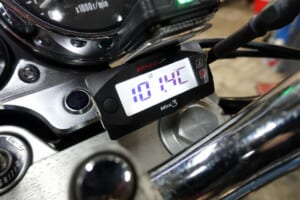
Instead of “the symptom shows up easily when coolant temperature rises,” try “it shows up around 100°C”
or instead of “the symptom shows up easily on the highway,” try “in 4th gear at 4000 RPM at ○○ km/h it happens, but not in any other gear.”
When you attach numbers to the symptom, it’s easier to communicate with the technician and easier for you to organize your thoughts.
It’s also good to imagine which system could be causing that symptom.
For example, if the case is “the fuse blows when RPM goes over 6000,” you don’t need to add anything—just think “how would a fuse blow?”
Sometimes, instead of dreading the mysterious fault, enjoying it can actually be the key to solving it.
If furrowing my brow and getting frustrated would solve the mysterious fault, I’d furrow it all day long.
But tackling it with the thought “oh, this is fun again”—I think that’s another way to enjoy it. (^^♪