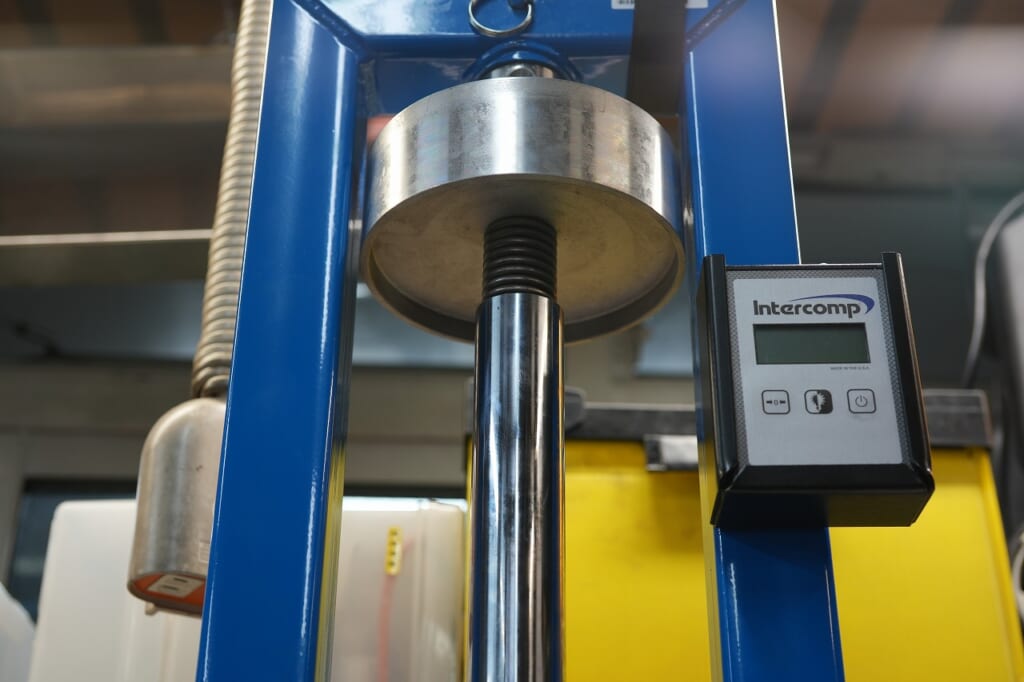
It’s convenient, I suppose.
As a device, it’s quite rough around the edges, I’d say…
When the rate is low, properly zeroing it out becomes a hassle (´;ω;`)
I also check the rear suspension rate when we do an OH.
Ah, so Öhlins prints the spring rate right on the spring itself. I didn’t know that.
Well, that’s obvious, isn’t it.
Being able to check fork springs is really handy.
With a single rate you can roughly calculate it with a calculator, but with a variable rate it gets a bit tricky.
Aftermarket fork springs that look super beefy sometimes turn out to have surprisingly ordinary rates when you check them.
Fork spring kits are surprisingly common, but most don’t disclose the spring rate information.
Without knowing that, you can’t adjust the front and rear rates, so you end up not using them at all.
It’s better to buy just the springs instead of a complete kit. As long as you know the original outer diameter, length, and rate, you can make it work however you want, so give it a try.
Fork spring measurement needs a bit more refinement…
By the way, this tester costs a fair bit too…