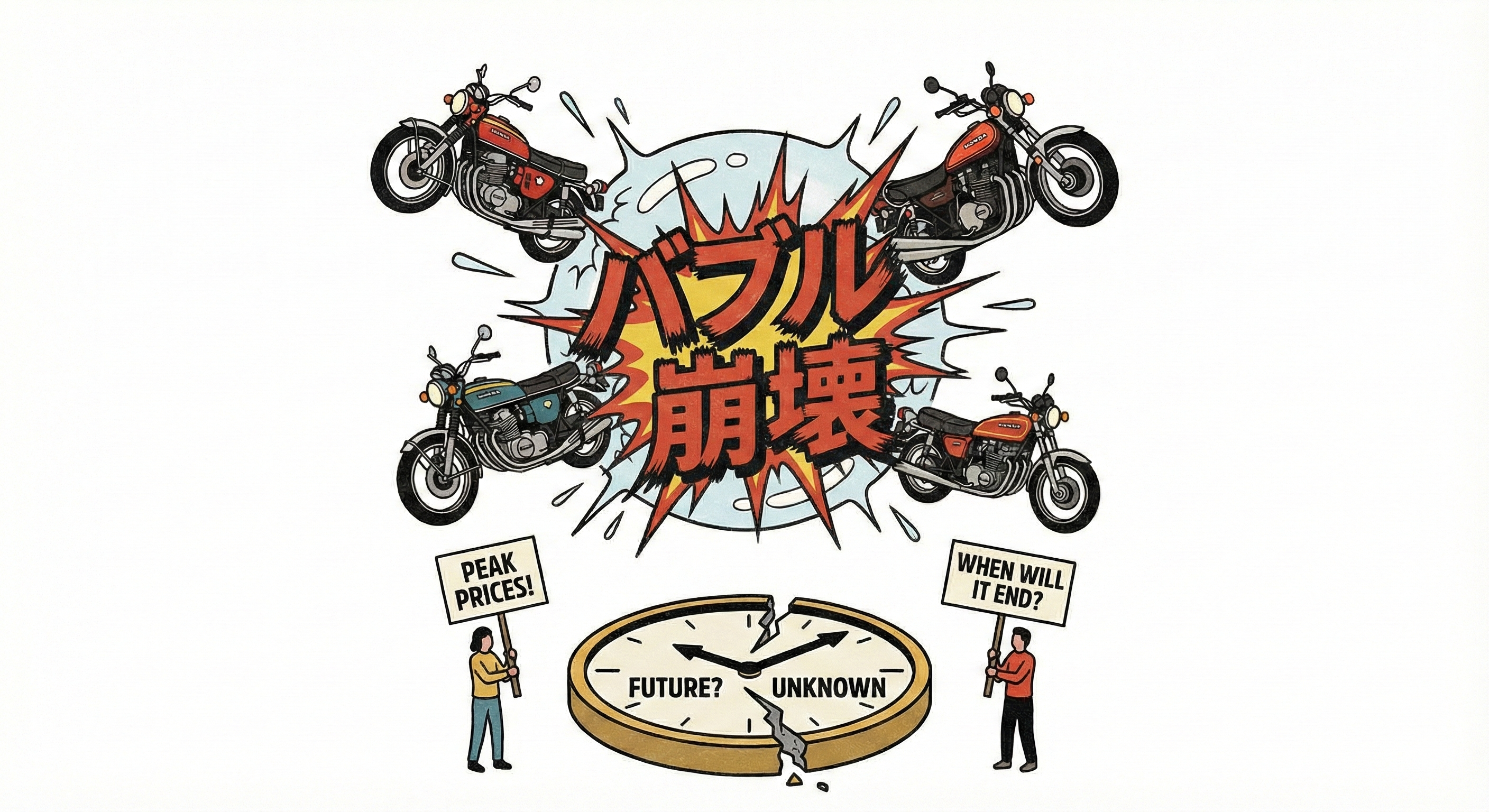
Over the past few years, used motorcycle prices have skyrocketed dramatically. I follow the market closely as a fan, and there’s no doubt the prices have risen significantly.
However, I don’t think this momentum can realistically continue. A sharp decline would have a major impact on the entire motorcycle industry. “It’s still okay! It’s still okay!” – but is it really?
I’ve been thinking about this from various angles.
Another blog by Decoboco. “RURAL GARAGE”
A secret room for non-motorcycle topics. I share content about everyday convenient items, relocation, delicious food, and life philosophy. ←click
The vintage motorcycle bubble is more of a “stabilization and adjustment phase” rather than a “collapse (crash)”
The vintage motorcycle bubble is entering more of a “stabilization and adjustment phase” rather than a “collapse (crash),” and the abnormal price surge at its peak is already winding down. This is the general view as of 2025.
Based on the latest market trends I’ve researched (late 2024 to early 2025), I’ve organized the current situation and future outlook.
1. Current Situation: Has the bubble burst?
While it’s not a complete “collapse” with a crash, prices are clearly declining and adjusting.
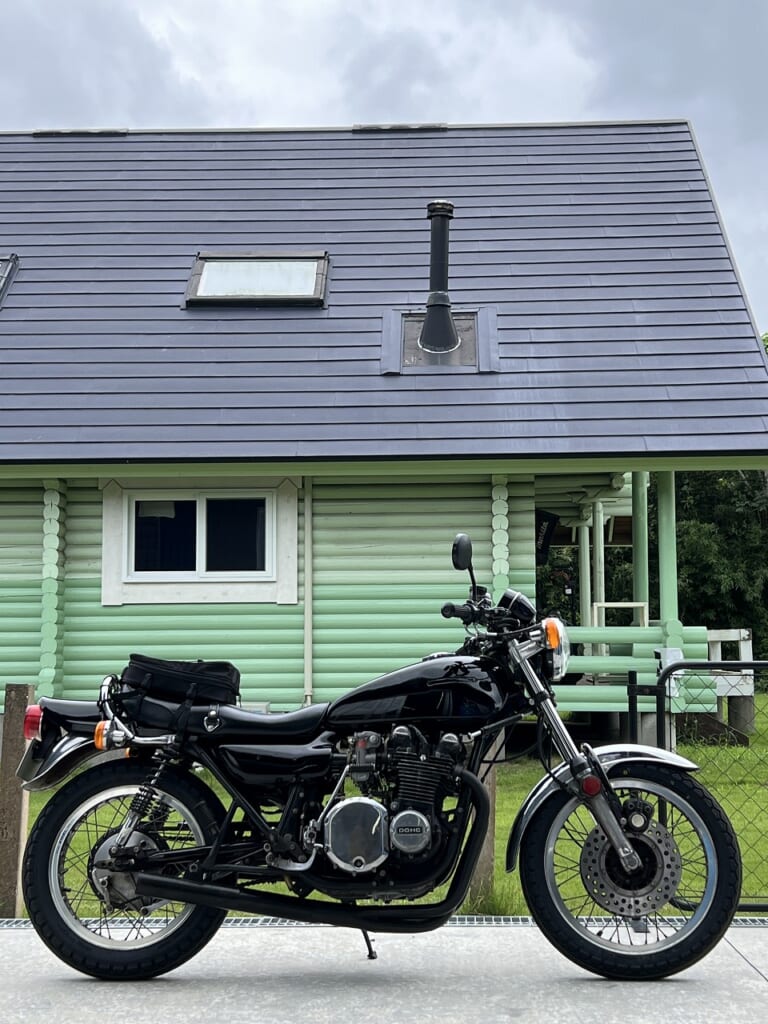
Ultra-popular models (Z1/Z2, CBX400F, etc.)
The days of “whatever price you ask, it will sell” are over.
According to data, 2025 buyback prices have dropped by several percent to 20% compared to peak prices (around 2022) for some models.
While “quality examples” still maintain high prices, “poorly maintained vehicles” and “vehicles that were inflated due to hype” are increasingly sitting unsold even with price reductions.
General used bikes and neo-classics
As new vehicle supply shortages have been resolved, the abnormal used prices that exceeded new vehicle MSRP have largely disappeared. This can be called a true bubble burst.
2. How long will high prices last? (Future predictions)
It’s unlikely that “explosive price surges like during the pandemic” will return, but **”gradual decline” or “price stabilization”** is predicted. A return to 2010s-level bargain prices seems unlikely.
The reason is that factors pushing prices down and factors supporting them are in balance.
【Factors pushing prices down】
Limits of domestic demand: Prices have risen so high that they’ve reached levels (3-5 million yen and above) beyond the reach of typical domestic riders, eliminating the buyer base.
“End-of-life” decisions by baby boomers and seniors: In the coming years, the generation that experienced the motorcycle boom is expected to increasingly sell their bikes due to aging (license returns or physical limitations), which could increase market supply.
【Factors supporting prices (preventing crashes)】
Weak yen and overseas demand: This is the biggest factor. With the yen remaining weak, Japanese vintage bikes still look like good value to overseas buyers. International demand for popular models like the Z1 is supporting floor prices through overseas exports.
Absolute shortage of inventory: Vintage bikes can’t be reproduced, so the total number only decreases. The value of “true discontinued models” never becomes zero.
3. Summary and advice
For buyers:
Speculative purchases are risky at this time.
If you’ve always wanted a particular bike and plan to keep it long-term, now that the market has cooled down might actually be a good time to make a more rational choice than before.
For sellers:
Don’t expect “prices will go higher if we wait a bit longer.” The market has peaked and is beginning to decline gradually. If you’re considering selling, it might be wise to act sooner rather than later.
2025 appears to be a transitional period from “speculative asset” to “hobby vehicle,” returning to its proper value.
What’s the future management direction for motorcycle shops holding large vintage bike inventories?
For shops holding large vintage inventories, this is truly a **“critical management decision point.”
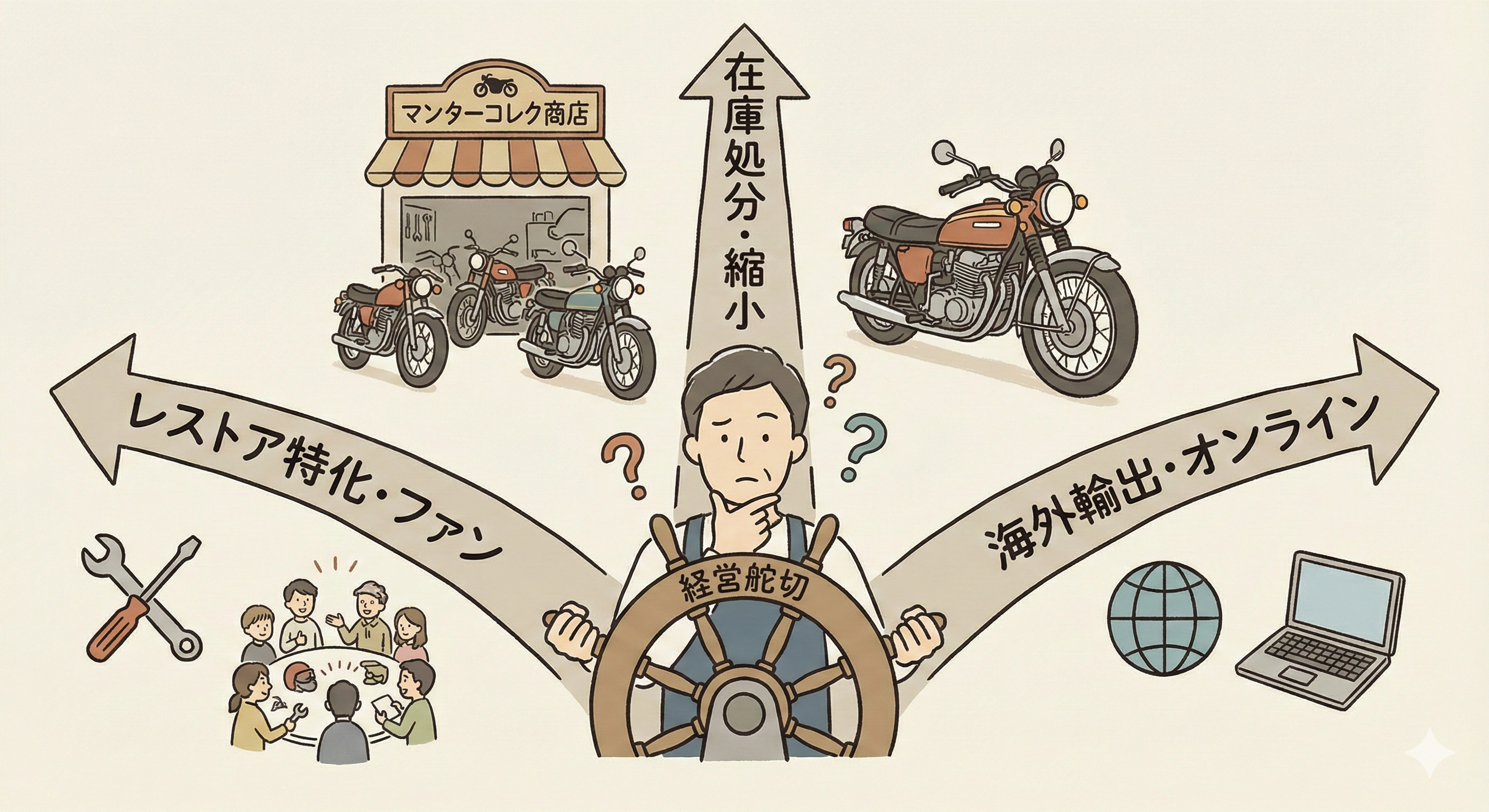
Given the 2025 market environment (declining domestic demand, continued weak yen, changing customer base), the era of simply “waiting for prices to rise” has ended. I believe the realistic survival strategy is to shift in one of three directions:
1. Inventory “triage (sorting)” and early cash conversion
Rather than treating all inventory the same, you need to clearly separate based on **”whether it has international market value”** and adjust disposal speed accordingly.
Group A: Vehicles with universal global asset value (Z1/Z2, CB750, FX, Katana, etc.)
Strategy: “Export” or “maintain strong pricing”
Models popular in the West are still good value for overseas buyers as long as the yen remains weak. Rather than forcing price cuts for domestic sales, strengthening export auction services or wholesale to exporters could yield higher prices. These are “still valuable” and don’t need to be dumped urgently.
Group B: Vehicles that rose due to domestic-only boom (mid-size naked bikes, gang-style bikes, etc.)
Strategy: “Accept losses and dispose early”
Models whose prices were inflated purely by “nostalgia” among 40-50 year-old Japanese riders face the highest risk of price decline as that generation’s purchasing power wanes. These vehicles “won’t appreciate if held,” so converting them to cash at current prices (even at thin margins or slight losses) to restore working capital is wise.
2. Shift from “vehicle sales” to “technical services (restoration, maintenance)”
When vehicle prices have skyrocketed so high that “vehicles won’t sell,” a shift to earning from existing owners’ service needs is required.
Capturing restoration demand:
While people can’t afford to buy new expensive vintage bikes, there’s a growing segment that wants to “repair their current bike and keep riding it long-term.”
Rather than simple repairs, packaging **”high-value-added services”** like engine overhauls, re-plating, and repainting can offset the decline in vehicle sales.
“Parts” business:
Selling rare OEM parts or reproduction parts can sometimes yield better profit margins than selling complete vehicles. In some cases, parting out dead inventory and selling pieces individually (via Yahoo Auctions or eBay) can generate higher total revenue.
3. “Rejuvenating” target customers and “going global”
“Older guys who remember the old days” can no longer keep up with inflated prices.
Developing overseas sales channels:
Multilingual website development and eBay listings provide risk hedging by reducing reliance on domestic platforms like GooBike.
Focusing on neo-classics and 250cc class:
If you continue sourcing inventory, shifting from overpriced discontinued models to 90s-00s vehicles (future neo-classics) that younger buyers can afford expands your customer base.
Conclusion: Which direction to steer?
Avoid “becoming a museum” (hoarding inventory for satisfaction) and instead become a “trading company” (exporting overseas) or “factory” (selling expertise).
In particular, how quickly you can convert **Group B inventory (domestic boom-dependent stock)** to cash, even at a painful loss, will determine the shop’s future viability.
Will motorcycle shop closures and bankruptcies increase in the coming years?
Yes, unfortunately, closures and bankruptcies are extremely likely to increase further.
Signs are already appearing in the data (surveys by Teikoku Databank, etc.) from 2024-2025, with “neighborhood bike shops” experiencing a surge in closures and dissolutions.
In particular, three types of shops are falling into critical situations:
1. Retailers caught with “overpaying” and missing the exit (direct impact of bubble burst)
This is the pattern being most feared.
Situation: During the bubble years (2021-2023), shops believing prices would keep rising purchased large quantities of vintage and popular bikes at “high acquisition prices.”
Why it’s dangerous: With prices now falling, selling means losses, while not selling prevents cash conversion and worsens cash flow. They’re caught in an “inventory trap.” When bank loan repayment deadlines approach, black-ink bankruptcies or losses from fire sales exhaust their resources.
2. Skilled shops with no “successors” (structural problem)
Actually, this **”resignation closure”** is far more common than financial bankruptcy.
Situation: Shops where the owner is elderly (70+) and mechanics are scarce.
Why it’s dangerous: Modern bikes require electronic controls and ABS, necessitating expensive diagnostic equipment (OBD tools, etc.). “I don’t want to invest millions in equipment just to keep going” and “my son says he won’t take over” – at this point, physical limits lead to closure decisions.
Situation: Shops that competed on turnover by cutting vehicle margins.
Why it’s dangerous: Shipping costs, parts (tires, oil), and utilities have all skyrocketed. Meanwhile, customer wallets are tightening and price increases are difficult. Margins compress further – each sale leaves less cash on hand, becoming unsustainable.
Future outlook: Industry “polarization” is advancing
Not all shops will fail. The future will split as follows:
Shops that survive:
Shops that can sell “expertise” at fair prices (shops where customers line up despite high labor rates).
Shops with overseas sales channels that can leverage the weak yen.
Shops with official dealer rights providing stable income from new vehicle supply and recall service.
Shops that will be eliminated:
Broker-type shops that just move used bikes from one hand to another with low maintenance skills.
Individual shops run on rough accounting.
If you have a shop you work with, **”Is inventory turnover slowing?” “Are maintenance bookings dropping dramatically (or conversely, are they so swamped they’re barely keeping up)?”** – these might be signs of whether that shop will survive.


 ポチップ
ポチップ